


Container Standards
ISO containers follow globally recognized standards for external dimensions, corner castings, handling, stacking, transport compatibility and intermodal operations.

Freight benchmarks declined during the latest reporting week, but persistent security threats, elevated fuel exposure, port disruption and route uncertainty continue to prevent a broad normalization of global container logistics.
| Indicator | Direction | Executive Assessment |
|---|---|---|
| Global Freight Market | ▼ Weakening | Drewry’s World Container Index fell 4% to US$4,374 per 40-foot container on 23 July, reflecting lower Asia–Europe and Transpacific spot quotations. |
| Container Availability | ► Stable | No verified global shortage has emerged, although local imbalances and delayed repositioning remain material around disrupted Middle Eastern and South Asian corridors. |
| New Container Prices | ► Stable | No sufficiently comprehensive official weekly global price series was published during the reporting period. |
| Used Container Prices | ► Stable | Regional availability remains the principal price differentiator; verified global weekly transaction data is not publicly available. |
| Container Leasing | ▲ Improving | Longer voyages, uncertain transit times and regional equipment dislocation support utilization and demand for flexible leasing capacity. |
| Schedule Reliability | ▼ Weakening | Cape of Good Hope diversions, weather disruption and congestion continue to increase voyage variability and equipment-cycle duration. |
| Port Congestion | ▼ Weakening | Operational reports identified congestion in China following Typhoon Bari, disruption in Antwerp and continuing pressure at selected Indian gateways. |
| Steel Prices | ► Stable | No verified weekly movement was sufficient to establish a uniform global direction for container-grade steel. |
| Shipbuilding Activity | ▲ Improving | Shipyard capacity remains heavily committed, while elevated newbuilding prices continue to support major Asian yards. |
| Container Manufacturing | ► Stable | Production capacity remains ample, but manufacturers face uncertainty over replacement demand, freight volatility and regional equipment imbalances. |
| Ocean Freight | ▼ Weakening | Spot rates eased during the week, although they remain supported by higher operating costs and geopolitical disruption. |
| Global Trade | ▲ Improving | UN Trade and Development estimated first-half 2026 goods trade at approximately US$13.7 trillion, 12.5% above the comparable 2025 period. |
| Geopolitical Risk | ▼ Weakening | The Red Sea, Suez Canal and Strait of Hormuz remain interconnected sources of operational, fuel and insurance risk. |
| AI Adoption | ▲ Improving | Shipping, forwarding and terminal operators continue investing in predictive planning, visibility, route optimization and document automation. |
| Infrastructure Investment | ▲ Improving | Port and terminal investment remains strategically important despite uncertain trade policy and financing conditions. |
| Fuel Markets | ▼ Weakening | Middle East security concerns and constrained maritime flows are maintaining unusually high fuel and LNG risk premiums. |
| Carbon Regulations | ▼ Weakening | Compliance pressure is increasing as IMO efficiency requirements and regional emissions policies move deeper into operational planning. |
Neutral
Demand indicators and global trade values remain supportive, but falling spot rates, geopolitical exposure and unreliable transit networks prevent a bullish classification.
Previous indicative reading: 58/100
The index declined by two points because softer freight benchmarks and deteriorating operational risk outweighed positive global trade data and continued infrastructure investment.
The Container Intelligence Index is an editorial composite indicator based on freight markets, container supply, trade growth, equipment availability, congestion, geopolitical risks, investment activity and market confidence. It is not a traded financial index.
The global container market moved into a more complex phase during the seven days ending 28 July 2026. Spot freight rates eased, but the decline should not be interpreted as a return to stable pre-disruption operating conditions. Drewry reported that its World Container Index fell 4% to US$4,374 per 40-foot container on 23 July, driven primarily by lower rates on Asia–Europe and Transpacific routes. :contentReference[oaicite:0]{index=0}
The rate decline occurred while geopolitical and operational risks remained elevated. Kuehne+Nagel’s chief executive stated that a broad return to normal Middle Eastern shipping conditions was unlikely in the near term. Many services continue to avoid high-risk corridors or operate under enhanced security, insurance and fuel-cost constraints. Cape of Good Hope routing can add approximately ten days to Asia–Europe voyages, extending equipment cycles and complicating carrier schedule recovery. :contentReference[oaicite:1]{index=1}
Global trade data remained constructive. UN Trade and Development estimated that goods trade reached approximately US$13.7 trillion during the first half of 2026, an increase of 12.5% from the corresponding period in 2025. The expansion was supported particularly by trade in technology-intensive goods, although the organization also warned of fragility arising from geopolitical tension, rising prices and uneven conditions across developing economies. :contentReference[oaicite:2]{index=2}
Port performance remained uneven. Rotterdam reported a 0.4% increase in total throughput to 212 million tonnes during the first half of 2026, while container throughput declined by 0.1% in TEU and 2.6% by tonnage. This divergence indicates that European container demand remains less robust than the port’s overall bulk and liquid cargo performance. :contentReference[oaicite:3]{index=3}
For decision-makers, the immediate implication is that freight prices may decline without equivalent improvement in reliability. Procurement strategies should therefore consider total landed cost, transit variability, inventory exposure, fuel surcharges and equipment availability rather than focusing exclusively on headline spot rates.
The principal measurable development was the 4% weekly decline in Drewry’s World Container Index. UN Trade and Development also released updated evidence of substantial year-on-year growth in global goods trade.
Underlying trade activity remains stronger than anticipated in several technology-linked sectors. Investment in ports, digital infrastructure and fleet efficiency also continues.
Middle East risk has become more closely linked to fuel-market volatility. Asian LNG prices for September delivery reached a four-month high of US$22 per million British thermal units amid concern over wider shipping disruption. :contentReference[oaicite:4]{index=4}
The main risk is a divergence between lower base freight rates and higher supplementary costs. The corresponding opportunity lies in flexible equipment leasing, alternative routing, inventory optimization and predictive logistics systems.
The weekly rate reduction indicates that carrier pricing power is being tested by additional capacity and more selective shipper demand. However, rates remain exposed to rapid reversals because the network continues to operate with longer voyages, elevated bunker costs and disrupted regional port calls.
The increase in first-half global trade provides a constructive demand foundation. Nevertheless, higher trade values do not translate automatically into equivalent container-volume growth because part of the increase reflects price effects and technology-intensive products with different value-to-volume ratios.
Security risk around the Red Sea, Suez Canal and Strait of Hormuz continues to affect carrier decisions. Some operators have explored limited Suez resumptions, but industry assessments remain cautious. The persistence of risk means that full schedule normalization cannot yet be incorporated into corporate planning.
Kuehne+Nagel’s operational update for 15–21 July reported congestion in Chinese ports after Typhoon Bari, disruption associated with wildfires in Canada and Southern Europe, and operational interruption in Antwerp. :contentReference[oaicite:5]{index=5}
The global freight market is moving through a controlled correction rather than a collapse. Spot rates declined on the principal east–west trades, but cost support remains substantially stronger than in a normal oversupplied market.
| Trade Lane | Current Assessment | Primary Drivers |
|---|---|---|
| Asia–Europe | Rates easing, operational risk elevated | Cape routing, Suez uncertainty, fuel cost and fluctuating peak-season demand |
| Transpacific | Softening from elevated levels | Front-loading, trade-policy uncertainty, new capacity and inventory management |
| Transatlantic | Comparatively stable | Moderate demand, available capacity and weaker congestion pressure |
| Intra-Asia | Volatile | Feeder disruption, weather, manufacturing cycles and Middle East connectivity |
| Middle East | High-risk and surcharge-sensitive | Security restrictions, insurance, fuel availability and suspended port calls |
| Latin America | Mixed | Seasonal exports, uneven equipment availability and regional currency exposure |
| Africa | Capacity-sensitive | Cape routing, transshipment pressure and limited schedule resilience |
Blank sailings and capacity adjustments are expected to remain important carrier tools. Shippers should distinguish between nominal vessel capacity and dependable weekly capacity, particularly where port omissions or schedule changes reduce effective service availability.
Global manufacturing capacity remains concentrated in China, with CIMC, CXIC and Singamas among the principal producers. No comprehensive official weekly production or factory-utilization data was published during the reporting period. The most important short-term variables remain steel input costs, replacement demand, leasing-company orders and the geographic distribution of empty equipment.
Official global weekly new-container pricing has not yet been published. Market direction is assessed as stable because production capacity remains available while geopolitical disruption supports selective replacement and positioning demand. Buyers should obtain quotations on a delivered-depot basis rather than comparing factory-gate prices alone.
Used-container values remain highly regional. Prices are influenced by depot inventory, container age, CSC status, repair condition, repositioning cost and local demand for storage or export equipment. Buyers may consult the editorial background resources covering container prices, container inspection and container maintenance.
The global fleet is not experiencing a universal equipment shortage. The more relevant issue is regional mismatch. Longer vessel rotations reduce the speed at which equipment returns to export markets, while disrupted feeder networks can create temporary shortages even when global fleet supply is sufficient.
Port conditions remain operationally manageable at the global level but vulnerable to localized shocks. Chinese gateways experienced congestion following severe weather. Antwerp faced a temporary operational incident, while Indian exporters reported delays, vessel shortages and congestion at Mundra and Jawaharlal Nehru Port amid renewed West Asian disruption. :contentReference[oaicite:6]{index=6}
Rotterdam’s first-half report showed total throughput of 212 million tonnes, up 0.4%, while container throughput decreased marginally by 0.1% in TEU. The 2.6% decline in container tonnage suggests a shift in cargo mix or lower average cargo weight per unit. :contentReference[oaicite:7]{index=7}
North American ports are preparing for continued cargo flows under uncertain trade-policy conditions. The Port of Los Angeles previously reported 3,279,704 TEU for the first four months of 2026, 2% above its five-year average but 2% below the front-loaded pace of 2025. :contentReference[oaicite:8]{index=8}
The strategic priority for terminal operators is to improve resilience through appointment systems, rail coordination, yard optimization, predictive arrival data and automated exception management.
China: China remains the central production and export base for containers and manufactured cargo. Weather-related congestion presents a near-term operational challenge, while broad manufacturing capacity limits the probability of a sustained global equipment-production shortage.
India: Exporters face rising logistics pressure from West Asian disruption, port congestion and vessel availability constraints. The country remains a structural growth market for manufacturing, ports and inland logistics.
Singapore and Malaysia: These hubs retain strategic importance as transshipment and bunkering centers. Diversion patterns can increase yard and berth pressure with limited notice.
South Korea and Japan: Shipbuilding remains the principal strategic exposure. Korean yards retain strength in advanced and alternative-fuel vessels, while Japanese builders continue emphasizing efficiency and fleet renewal.
Vietnam and Thailand: Export-led manufacturing supports container demand, but both markets remain sensitive to feeder connectivity, transshipment performance and changes in United States and European trade policy.
Northern European ports are operating in a low-growth container environment. Rotterdam’s broadly flat TEU performance illustrates the divergence between resilient total port activity and more subdued containerized cargo. Germany, Belgium and the Netherlands continue investing in rail, terminal productivity, energy transition and digital port systems.
France, Italy, Spain and the United Kingdom face a combination of weak industrial demand, changing trade patterns and regulatory costs. Poland retains a comparatively constructive position as an industrial, warehousing and hinterland logistics market.
United States import activity remains influenced by inventory positioning and trade-policy uncertainty. Cargo owners are balancing the cost of early shipment against tariff, capacity and seasonal risks. Canada remains exposed to rail performance and wildfire disruption. Mexico continues to benefit from manufacturing investment, but border and inland transport capacity require continued expansion.
The UAE, Saudi Arabia, Qatar and Oman retain long-term infrastructure and logistics potential, but immediate operating conditions are dominated by security, insurance and energy-market risk. Egypt remains directly exposed to lower Suez activity, while Israel-related regional tensions continue to affect shipping assessments.
Security concerns continue to restrict normal operations through the Red Sea and adjoining Middle Eastern corridors. Industry participants remain cautious about a full return to Suez routing. Asian LNG prices for September delivery rose to US$22 per million British thermal units during the reporting period. :contentReference[oaicite:9]{index=9}
The principal container-market effect is indirect but significant. Higher crude oil, marine fuel and LNG prices increase voyage costs and surcharge risk. Avoidance of strategic waterways lengthens voyages, absorbs vessel capacity and delays equipment repositioning.
Official, directly comparable weekly global prices for VLSFO and MGO were not available from a single public primary source at the time of publication. Therefore, no unsupported bunker-price average is presented.
Shipbuilding activity remains concentrated in China, South Korea and Japan. Clarksons-linked industry data for May placed China’s share of global new orders at approximately 65% and South Korea’s at 19%. The Clarksons Newbuilding Price Index was reported at 185.01, maintaining the longer-term elevated price environment. :contentReference[oaicite:10]{index=10}
For container carriers, the strategic issue is the interaction between a large delivery pipeline and continuing route disruption. New vessel supply would normally pressure freight rates, but longer voyages and slower network velocity absorb part of the additional capacity.
Alternative-fuel readiness, energy efficiency, fleet renewal and regulatory compliance remain central to ordering decisions. Owners must assess not only vessel price but also fuel availability, lifecycle emissions, charter-market acceptance and infrastructure compatibility.
Artificial intelligence adoption is expanding across container shipping, ports and logistics. Priority applications include predictive estimated times of arrival, route optimization, yard planning, empty-container forecasting, document validation, customs classification, predictive maintenance and automated customer communication.
The immediate commercial value lies in exception management rather than fully autonomous operations. Systems that identify late vessels, missed connections, container dwell risks or equipment shortages before they become operational failures can reduce detention, demurrage and inventory costs.
Digital twins and machine-vision systems can improve terminal planning and equipment inspection. Smart-container sensors provide location, temperature, door and shock data, but cybersecurity and data-governance controls must develop at the same speed as connectivity.
The main adoption constraints remain fragmented data standards, legacy systems, uncertain model accountability and the quality of carrier and port event data.
IMO requirements continue to increase the importance of vessel efficiency and carbon-intensity management. The IMO’s 2023 greenhouse-gas strategy targets at least a 40% reduction in carbon intensity by 2030 compared with 2008 and seeks zero or near-zero-emission energy sources to represent at least 5%, while striving for 10%, of shipping energy use by 2030. :contentReference[oaicite:11]{index=11}
The IMO has also adopted a North-East Atlantic Emission Control Area introducing stricter limits on nitrogen oxides, sulphur oxides and particulate matter. Entry into force is scheduled for September 2027, with operational effect in 2028. :contentReference[oaicite:12]{index=12}
For container markets, decarbonization will influence vessel design, fuel procurement, port investment and freight contracts. Cargo owners should expect emissions data and low-carbon service options to become increasingly important in tendering processes.
No single corporate transaction announced during the seven-day reporting period materially changed the global container industry’s competitive structure. The broader strategic pattern remains focused on fleet renewal, terminal control, integrated logistics, digital visibility and alternative-fuel capability.
Maersk and Hapag-Lloyd’s earlier decision to resume selected Suez sailings under the Gemini network demonstrates the commercial importance of shorter routing, but the limited scope of the change and continuing regional security concerns prevent it from representing a general normalization. :contentReference[oaicite:13]{index=13}
Infrastructure investment remains attractive where projects improve terminal capacity, inland rail connectivity, energy supply, automation or resilience. Investors should differentiate between volume-dependent expansion and productivity-focused investment capable of generating returns without aggressive throughput assumptions.
Spot freight rates declined during the week. Global trade values increased substantially in the first half of 2026. Middle East shipping risk remained elevated. Port performance was uneven, with localized congestion and broadly flat first-half container throughput in Rotterdam.
The market is displaying a significant separation between price direction and operating quality. Freight rates can decline because additional vessel capacity and shipper resistance weaken carrier pricing, while reliability remains poor because geopolitical diversions and congestion continue.
The most important structural shift is the growing value of flexibility. Fixed routing assumptions, minimal inventory buffers and procurement based solely on spot rates expose companies to disruption. Flexible contracts, diversified gateways, equipment visibility and scenario-based planning are becoming durable competitive advantages.
The current freight-rate correction may be temporary if fuel costs rise or security conditions deteriorate. By contrast, digitalization, carbon regulation, supply-chain diversification and investment in resilient infrastructure represent longer-term market drivers.
Compare purchase and leasing alternatives using delivered cost, depot location, inspection status and expected holding period. Avoid delaying essential procurement solely in anticipation of lower factory prices.
Segment inventory by location, condition and customer use. Regional shortages can create attractive opportunities even when global equipment supply is sufficient.
Longer voyage cycles and regional imbalance support utilization. Maintain discipline on residual values and counterparty exposure.
Balance capacity deployment against fuel risk and rate erosion. Schedule integrity should be prioritized where customers assign high value to reliability.
Align production with verified customer demand and maintain flexibility in steel procurement. Avoid overreliance on short-lived replacement cycles.
Provide customers with transparent comparisons of base rates, surcharges, transit risk and alternative routing. Predictive visibility should be integrated into exception-management workflows.
Prioritize assets and platforms that improve port efficiency, equipment utilization, inland connectivity, automation, emissions compliance or data quality.
| Risk | Status | Probability | Potential Impact | Industries Most Affected |
|---|---|---|---|---|
| Red Sea and Suez security | Active | High | Longer transit times, higher fuel consumption and reduced schedule reliability | Carriers, forwarders, importers, manufacturers |
| Strait of Hormuz disruption | Elevated | Medium to High | Fuel-price shocks, insurance increases and Middle East service disruption | Shipping, energy, chemicals, logistics |
| Extreme weather | Active seasonal risk | High | Port closures, congestion and schedule delays | Ports, carriers, exporters, retailers |
| Port congestion | Localized | Medium | Higher dwell time, detention and missed connections | Forwarders, shippers, terminals |
| Fuel volatility | Elevated | High | Surcharges and higher transport costs | Carriers, importers, logistics providers |
| Tariffs and trade disputes | Uncertain | Medium | Front-loading, route shifts and inventory distortion | Manufacturers, retailers, importers |
| Cybersecurity | Persistent | Medium | Terminal interruption, documentation failure and cargo delay | Ports, carriers, digital platforms |
| Currency volatility | Elevated | Medium | Changes in equipment and freight purchasing costs | Traders, manufacturers, leasing companies |
All quantitative information contained in this report is derived from publicly available primary sources, official statistics, recognised industry intelligence providers, or verified corporate disclosures available at the time of publication. Forward-looking statements are clearly identified as analytical expectations and should not be interpreted as established facts.
Editorial background resources: Global Container Network, Container Marketplace, Container Leasing, Container Manufacturers, Container Shipping and Container Depots.
The Global Container Knowledge Center provides structured business information about ISO shipping containers, container types, dimensions, weights, inspection standards, certification, logistics processes and international container market requirements.
This page is designed for companies, procurement teams, logistics managers, freight forwarders, exporters, importers, project cargo specialists and international organizations that need reliable container knowledge before buying, selling, leasing, inspecting or transporting containers worldwide.
Shipping containers are standardized transport units used across ocean freight, rail freight, road transport, inland logistics, project cargo, storage, construction, mining, energy, humanitarian operations and industrial supply chains. Their value is not limited to physical steel construction. In professional B2B trade, containers are commercial assets, transport equipment, storage infrastructure and logistics instruments at the same time.
A reliable container decision requires more than choosing between a 20-foot or 40-foot unit. Buyers, sellers, leasing companies, freight forwarders and industrial customers must understand container dimensions, payload, tare weight, cubic capacity, structural condition, CSC validity, container grade, door condition, floor quality, corrosion level, repair status, depot location, transport availability and intended use.
Global Container Network structures this knowledge for international business users who need practical, commercially relevant and technically accurate container information for worldwide container sourcing, trading, leasing and logistics coordination.
ISO containers follow globally recognized standards for external dimensions, corner castings, handling, stacking, transport compatibility and intermodal operations.
Containers are used for cargo movement, storage, resale, leasing, fleet operations, industrial projects, emergency logistics and international supply chain management.
Professional container decisions depend on equipment type, location, technical condition, documentation, availability, pricing, transport cost and operational suitability.
An ISO shipping container is a standardized freight unit designed for international cargo movement by sea, rail and road. The main purpose of this standardization is simple: a container loaded at one location can be handled by cranes, trucks, trains, vessels and container depots across the world without changing the cargo unit itself.
In global B2B logistics, the container is not only a transport box. It is a commercial asset, a logistics interface and a standardized trade instrument. A container can be purchased, leased, repositioned, stored, inspected, repaired, certified and traded internationally.
The most common ISO containers are 20-foot and 40-foot dry freight containers. However, global container logistics also includes high cube containers, open top containers, flat racks, platform containers, refrigerated containers, tank containers, side door containers, double door containers and specialized units for project cargo, offshore use and industrial applications.
ISO containers are built around globally recognized external dimensions and corner fittings, allowing international compatibility across vessels, terminals, trucks, trains and lifting equipment.
The same container can move through ocean freight, rail freight, road transport and depot handling without unloading the cargo between transport modes.
Containers can be used for cargo transport, temporary storage, long-term storage, resale, leasing, modified structures, industrial projects and global supply chain operations.
Different cargo flows require different container types. A professional container decision should always match the cargo, loading method, route, handling requirements, temperature requirements and regulatory situation. In B2B procurement, the wrong container type can create unnecessary transport costs, cargo risk and operational delays.
| Container Type | Professional Use | Typical B2B Application |
|---|---|---|
| Dry Container | General cargo, packed goods, machinery, retail products | Import, export, storage, trading, industrial logistics |
| High Cube Container | Higher internal volume and additional vertical clearance | Light but voluminous cargo, furniture, equipment, modifications |
| Open Top Container | Cargo loaded from above by crane | Machinery, oversized cargo, construction equipment |
| Flat Rack Container | Heavy, wide or irregular cargo | Project cargo, vehicles, industrial plants, steel structures |
| Reefer Container | Temperature-controlled cargo | Food, pharmaceuticals, chemicals, cold-chain logistics |
| Tank Container | Liquids, gases and bulk liquid cargo | Chemical logistics, food-grade liquids, industrial liquids |
Container dimensions are one of the most important decision factors in professional container procurement. The external size determines transport compatibility and handling, while the internal dimensions define the usable cargo space. In practice, the exact measurements may vary slightly depending on manufacturer, production year and container design.
| Container Size | External Length | External Width | External Height | Typical Use |
|---|---|---|---|---|
| 20 ft Standard | Approx. 6.06 m | Approx. 2.44 m | Approx. 2.59 m | Heavy cargo, dense goods, storage, export cargo |
| 40 ft Standard | Approx. 12.19 m | Approx. 2.44 m | Approx. 2.59 m | General cargo, export shipments, storage, resale |
| 40 ft High Cube | Approx. 12.19 m | Approx. 2.44 m | Approx. 2.90 m | High-volume cargo, furniture, modified containers |
| 45 ft High Cube | Approx. 13.72 m | Approx. 2.44 m | Approx. 2.90 m | Large-volume logistics, European transport, special projects |
Note: Container dimensions are approximate business reference values. Exact dimensions should always be checked against the specific container data plate, manufacturer documentation or depot inspection report.
Weight specifications are among the most important technical characteristics of every ISO shipping container. Incorrect weight calculations may lead to loading restrictions, transport delays, higher freight costs, safety issues and regulatory violations. Professional container procurement therefore always considers tare weight, payload capacity and maximum gross weight before equipment selection.
International carriers, shipping lines, port terminals and freight forwarders rely on standardized weight information for vessel planning, cargo stowage, crane operations and intermodal transport. Understanding these values is essential for efficient logistics planning.
| Term | Meaning | Business Importance |
|---|---|---|
| Tare Weight | Weight of the empty container. | Determines available loading capacity. |
| Payload | Maximum permitted cargo weight. | Critical for freight planning and legal compliance. |
| Maximum Gross Weight | Container plus cargo. | Maximum allowable transport weight. |
| Cubic Capacity | Internal loading volume. | Important for lightweight and high-volume cargo. |
The technical condition of a shipping container has a direct impact on operational safety, resale value, maintenance costs and long-term usability. Professional buyers evaluate considerably more than external appearance.
Floor integrity, door sealing performance, structural strength, corrosion, roof condition, side wall deformation, corner casting geometry and CSC validity are among the most important evaluation criteria during container inspection.
Newly manufactured containers with no commercial operating history. Often referred to as "One Trip Containers" after the initial positioning voyage.
Equipment transported once from the manufacturing country to the destination market. Excellent condition with minimal wear.
Suitable for international cargo transport. Meets applicable structural and safety requirements after inspection.
Suitable for secure storage. Doors, roof and walls protect against weather penetration.
Equipment sold without refurbishment. Repairs or maintenance may be required before operational use.
Previously used container that has undergone professional inspection, repair and quality improvements.
Professional inspection reduces commercial risk and increases investment security. Buyers should verify both structural integrity and operational suitability before purchasing or leasing shipping containers.
Roof, side panels, doors, corner posts, welds, corrosion and structural deformation.
Floor condition, moisture, contamination, odors, previous cargo residues and cleanliness.
Hinges, locking bars, handles, seals, opening and closing performance.
Verification of valid CSC certification, identification markings and inspection history.
Owner code, serial number, ISO size code, operational markings and equipment identification.
Evaluation of the container's suitability for export, storage, leasing, resale or modification.
CSC certification is one of the most important safety requirements in international container logistics. The CSC plate confirms that a container has been approved under the Convention for Safe Containers and is suitable for international transport when it remains structurally safe and properly maintained.
For professional buyers, leasing companies, freight forwarders and cargo owners, CSC validity is a central decision factor. A container without valid CSC status may still be useful for static storage, but it may not be accepted for international cargo movement by shipping lines, terminals or intermodal operators.
The CSC plate indicates that the container was approved for safe handling, lifting, stacking and transport according to international safety requirements.
The inspection date or ACEP marking helps determine whether the container remains valid for international transport operations.
Shipping lines, ports and depots may reject containers that are structurally unsafe, expired or missing required certification information.
Valid CSC status can increase resale value and operational usability, especially for cargo-worthy containers used in international trade.
ISO 6346 is the international identification system used for freight containers. It defines how containers are marked with an owner code, equipment category identifier, serial number and check digit. This identification structure allows containers to be tracked, verified and documented across global transport chains.
A standard container number usually consists of four letters followed by seven digits. The first three letters identify the owner or operator, the fourth letter identifies the equipment category, six digits form the serial number and the final digit is the check digit.
| Element | Example | Meaning |
|---|---|---|
| Owner Code | GCN | Identifies the container owner or registered operator. |
| Category Identifier | U | Indicates freight container equipment. |
| Serial Number | 123456 | Unique numerical container identification. |
| Check Digit | 7 | Used to validate the container number mathematically. |
Container markings provide essential information for transport operators, terminals, depots, customs processes, leasing companies and cargo owners. These markings help identify the container, determine its size and type, verify weight limits and support safe handling during international logistics operations.
The container number is the primary identification code used for tracking, documentation, release orders, depot records and transport coordination.
This code indicates the container length, height and equipment type, such as standard dry container, high cube or specialized container.
The maximum gross weight shows the permitted total weight of the container including cargo and is critical for safety and legal compliance.
Tare weight identifies the empty weight of the container and is required to calculate available payload capacity correctly.
Payload capacity defines the permitted cargo weight and must be checked before loading heavy goods or dense industrial cargo.
The CSC plate contains approval, inspection and safety information required for international container movement.
Container knowledge becomes commercially valuable when it is applied to real logistics decisions. Companies sourcing containers internationally must consider not only purchase price, but also depot location, transport costs, port access, availability, customs requirements, inspection status, documentation and final destination.
The same container can have different business value depending on its location. A cargo-worthy 40 ft high cube container in a major export hub can be more valuable than a similar unit in a low-demand inland depot, because repositioning costs and regional demand strongly influence the final commercial result.
Container availability depends on local inventory, regional trade flows, depot capacity and the balance between import and export demand.
Moving empty containers between regions can significantly affect total cost and should be included in professional procurement calculations.
Ports with strong vessel schedules, rail connections and inland transport networks often offer better container trading and logistics conditions.
Container release, ownership transfer, leasing agreements, inspection reports and transport documents must be coordinated professionally.
A shipping container moves through several commercial stages during its operational life. It may begin as newly manufactured equipment, enter international cargo service, move into leasing fleets, be sold as used equipment, repaired, refurbished, converted or finally used for static storage and industrial applications.
Containers are produced according to international standards with steel structure, corner castings, flooring, doors, locking bars and protective coating systems.
After production, containers enter global trade routes and are used by shipping lines, leasing companies, freight forwarders and cargo owners.
Regular inspection, structural repair, floor repair, door adjustment and corrosion treatment help extend the commercial service life of container equipment.
Used containers may be resold, refurbished, leased, modified for storage, converted for industrial use or integrated into project-based logistics solutions.
Professional container maintenance protects asset value and operational reliability. Even strong steel containers require regular checks because transport, stacking, weather, handling and cargo residues can affect structural condition and usability.
Roof dents, holes and corrosion can create water ingress risk and should be checked before storage or cargo use.
Container floors must be inspected for moisture, cracks, contamination, weak sections and forklift damage.
Door gaskets, hinges, locking bars and handles must work properly to keep cargo protected and operations safe.
Surface rust can be treated, but deep corrosion near structural areas requires careful technical assessment.
Empty container repositioning is a major cost factor in global container logistics. A container may be available at an attractive purchase price, but if it is located far away from the intended use area, inland transport, depot charges and handling costs can change the real business calculation.
Professional container sourcing therefore evaluates price, condition and location together. The best commercial decision is not always the cheapest container, but the container with the best total cost, suitable condition and reliable availability at the required location.
A cargo-worthy container is suitable for international cargo transport after inspection and must meet relevant structural and safety requirements.
CSC refers to the Convention for Safe Containers. The CSC plate confirms safety approval and inspection information for international transport use.
A one-trip container is newly manufactured equipment that has usually completed only one transport movement from the production country to the destination market.
The most common international container sizes are 20 ft standard, 40 ft standard and 40 ft high cube containers.
Tare weight is the empty weight of the container. It is used to calculate the remaining permitted cargo payload.
Payload is the maximum permitted cargo weight that can be loaded into the container under its technical and regulatory limits.
Used containers can be exported if they are structurally suitable, properly documented and accepted by the relevant carrier, depot or shipping line.
Container prices are influenced by condition, size, location, availability, transport cost, market demand, leasing activity and regional trade flows.
Learn more about dry containers, high cube containers, reefers, flat racks, open tops and specialized container equipment.
Compare standard container sizes, external dimensions, internal loading space, cubic capacity and practical cargo suitability.
Understand container availability, price trends, leasing demand, regional supply and global trade effects.
Explore port handling, depot operations, inland transport, intermodal movement and international freight coordination.
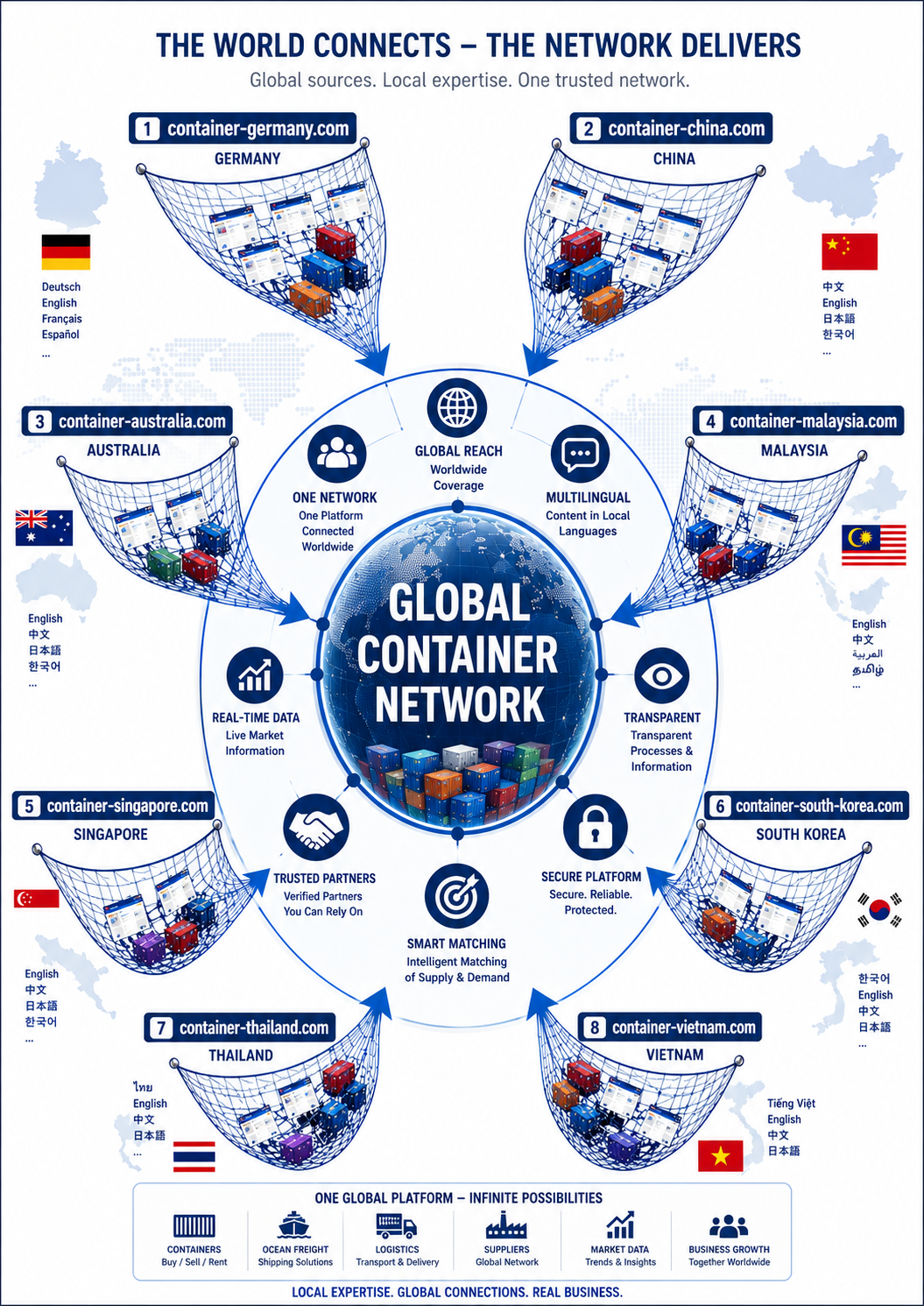
Global Container Network supports international B2B communication for container sourcing, container trading, leasing, logistics coordination, supplier matching and professional container market information.
Contact Global Container Network

© ਕੰਟੇਨਰ-ਨੈੱਟਵਰਕ.ਕਾੱਮ