EXECUTIVE WHITEPAPER
THE DIGITAL TRANSFORMATION OF THE GLOBAL CONTAINER INDUSTRY
Why Information, Intelligence and Global B2B Networks Will Shape the Future of Container Trade
Executive Whitepaper 2026
Prepared for:
- Shipping Lines
- Container Manufacturers
- Container Leasing Companies
- Global Traders
- Port Operators
- Freight Forwarders
- Investors
- Governments
- Procurement Executives
- Logistics Companies
- Infrastructure Investors
SECTION 1
Executive Summary
The Global Container Economy Is Entering a New Era
The international container industry represents one of the most important infrastructures of the global economy. Every day, millions of containers transport industrial products, raw materials, consumer goods, food, machinery and strategic resources across continents, connecting manufacturers, suppliers, ports and customers within highly complex global supply chains.
According to the United Nations Conference on Trade and Development (UNCTAD), more than 80 percent of global merchandise trade by volume is transported by sea, making maritime transport the backbone of international commerce.
Containerization has transformed international trade more profoundly than almost any other logistics innovation of the past century. Standardized ISO containers have dramatically reduced transportation costs, increased cargo security, shortened loading times and enabled truly global manufacturing networks.
Today, the worldwide container ecosystem extends far beyond shipping itself. It includes manufacturers, leasing companies, traders, depots, repair facilities, logistics providers, freight forwarders, ports, customs authorities, financial institutions and technology companies operating across every major economy.
Despite its enormous economic importance, the industry remains highly fragmented.
Thousands of container suppliers operate independently.
Leasing companies maintain separate inventories.
Regional container traders rarely have global visibility.
Depot capacities are often difficult to identify.
International buyers frequently spend days identifying reliable suppliers in unfamiliar markets.
As a result, procurement processes remain inefficient compared with many other industrial sectors that have already undergone comprehensive digital transformation.
Digitalization Is Reshaping Global Procurement
Over the past decade, digital transformation has fundamentally changed how businesses identify suppliers, evaluate markets and make purchasing decisions.
Traditional keyword-based internet searches are increasingly being replaced by AI-powered information systems capable of understanding business intent, market context and semantic relationships.
Decision makers increasingly expect:
- verified market intelligence
- structured information
- transparent supplier ecosystems
- trusted business data
- actionable insights
rather than isolated search results.
This shift fundamentally changes how companies discover new business opportunities.
The value of reliable information is becoming nearly as important as the value of the physical products themselves.
Information Has Become a Strategic Asset
Historically, companies competed primarily through manufacturing capabilities, logistics performance and pricing.
Today, competitive advantage increasingly depends on:
- information quality
- market transparency
- data accessibility
- digital visibility
- international reach
Organizations capable of combining market intelligence with digital business networks are positioned to improve procurement efficiency, reduce transaction costs and accelerate decision-making.
This transformation is occurring across numerous industries including manufacturing, finance, healthcare and industrial procurement.
The global container industry is now entering the same evolution.
From Information to Business Opportunities
The future of digital procurement is unlikely to rely solely on information portals or traditional marketplaces.
Instead, successful ecosystems increasingly combine:
- market intelligence
- supplier discovery
- digital networking
- transaction support
- business matchmaking
- international visibility
into one integrated environment.
Such platforms allow companies to move seamlessly from understanding market developments to identifying qualified suppliers and initiating business relationships.
The Emergence of Integrated Container Ecosystems
This Executive Whitepaper examines how integrated digital ecosystems may reshape the international container industry during the coming decade.
It explores the convergence of:
- market intelligence
- artificial intelligence
- digital procurement
- international B2B networking
- semantic search
- knowledge graphs
- global supplier ecosystems
and evaluates how these developments influence purchasing behaviour across the container economy.
Two Complementary Building Blocks
Within this context, two complementary digital initiatives illustrate how information and business connectivity can reinforce one another.
Container Intelligence
Container Intelligence focuses on delivering high-quality market information, strategic analysis, industry research and decision-support content covering topics such as:
- global container markets
- leasing trends
- freight developments
- manufacturing capacity
- supply chain risks
- container availability
- port infrastructure
- maritime economics
Its objective is to improve transparency and support better-informed business decisions.
Global Container Network
Global Container Network represents an international B2B platform designed to improve visibility across the global container ecosystem by connecting companies involved in:
- container manufacturing
- container trading
- container leasing
- container rental
- depot services
- transportation
- logistics
- container sales
- container purchasing
- specialized container solutions
Rather than functioning as a traditional e-commerce marketplace, the platform is intended to facilitate international business discovery and supplier visibility across multiple geographic markets.
Relevant platform sections include:
Global Marketplace
https://www.globalcontainernetwork.com/en/marketplace
Container Leasing
https://www.globalcontainernetwork.com/en/leasing
Container Manufacturers
https://www.globalcontainernetwork.com/en/manufacturers
Container Depots
https://www.globalcontainernetwork.com/en/container-depots
A Changing Competitive Landscape
The container industry has historically relied on established business relationships, regional expertise and personal networks.
However, several structural developments are accelerating digital transformation:
- growing international sourcing activities
- increasing supply chain diversification
- geopolitical uncertainties
- fluctuating freight rates
- regional equipment imbalances
- expanding AI-supported procurement
- increasing demand for supplier transparency
As these trends continue, digital business ecosystems capable of combining trusted information with qualified supplier networks are expected to become increasingly valuable.
Purpose of this Whitepaper
This Executive Whitepaper provides an independent strategic assessment of the ongoing digital transformation of the international container economy.
It evaluates:
- current market structures
- industry challenges
- technological developments
- digital procurement trends
- platform economics
- future market opportunities
while positioning integrated information and networking platforms within the broader evolution of global trade.
The objective is not promotional.
Instead, this paper seeks to provide decision makers with a structured framework for understanding how digital ecosystems may influence competitiveness throughout the global container industry over the coming decade.
Sources (Section 1)
- United Nations Conference on Trade and Development (UNCTAD) – Review of Maritime Transport
- UNCTADstat – Global Container Port Throughput
- World Shipping Council – Industry Statistics
- International Maritime Organization (IMO)
- World Trade Organization (WTO)
- OECD Trade Facilitation Studies
The Global Container Economy
Structure, Market Size and Strategic Importance
2.1 The Backbone of Global Trade
The international container industry is one of the world's most important economic infrastructures. Every modern supply chain—whether serving the automotive, pharmaceutical, electronics, renewable energy, food, retail or manufacturing sectors—depends on the reliable movement of standardized shipping containers.
Without containerization, today's highly integrated global economy would not exist in its current form.
According to the United Nations Conference on Trade and Development (UNCTAD), maritime transport carries approximately 80% of global merchandise trade by volume and around 70% by value. Containers account for the overwhelming majority of manufactured goods transported internationally.
The standardization introduced through the ISO container has fundamentally transformed international logistics by reducing transport costs, increasing cargo security and enabling intermodal transport across ships, railways and trucks without repacking cargo.
Today, more than 6,000 commercial ports worldwide participate in container logistics, while approximately 940–950 million TEU are handled annually across global container terminals.
2.2 The Economic Value of Containerization
Containerization is frequently described as one of the most influential innovations in modern economic history.
Its introduction has:
- dramatically reduced international transport costs
- shortened loading and unloading times
- minimized cargo damage
- increased supply chain reliability
- enabled global outsourcing
- facilitated just-in-time manufacturing
- accelerated international trade expansion
Economists generally agree that standardized container shipping contributed significantly to globalization over the past five decades.
Today virtually every internationally traded manufactured product has, at some point, travelled inside a shipping container.
2.3 The Global Container Ecosystem
The container industry consists of a highly interconnected network of specialized participants.
Market SegmentPrimary FunctionContainer ManufacturersProduction of ISO containersShipping LinesMaritime transportationContainer Leasing CompaniesEquipment financing and fleet managementContainer TradersPurchase and resale of containersContainer Rental ProvidersShort- and long-term equipment supplyContainer DepotsStorage, inspection and repairLogistics CompaniesInland transportationFreight ForwardersCargo organizationCustoms BrokersRegulatory compliancePort OperatorsTerminal handlingInspection CompaniesCSC inspections and quality controlFinancial InstitutionsTrade financeInsurance CompaniesCargo and equipment insuranceDigital PlatformsBusiness networking and supplier discovery
Every segment depends upon timely information exchange.
However, these market participants frequently operate on isolated digital infrastructures.
2.4 A Fragmented Global Marketplace
Unlike industries such as aviation, hospitality or financial services, the container sector has not yet developed a universally adopted digital infrastructure connecting all market participants.
Instead, companies often rely upon:
- existing customer relationships
- regional broker networks
- email communication
- spreadsheets
- telephone negotiations
- individual supplier databases
While many companies operate sophisticated internal systems, international market transparency remains relatively limited.
This fragmentation creates several structural inefficiencies.
Buyers often struggle to identify:
- reliable suppliers
- regional availability
- current leasing opportunities
- depot capacities
- specialized equipment
- local market conditions
Suppliers, on the other hand, frequently face challenges in reaching qualified international buyers.
2.5 Digital Procurement Is Changing Buyer Behaviour
Procurement executives increasingly begin supplier evaluations through digital research.
Modern purchasing processes typically involve:
- Market research
- Industry analysis
- Supplier identification
- Risk assessment
- Price comparison
- Commercial negotiation
- Contract execution
Artificial Intelligence increasingly supports the first four stages.
Consequently, organizations with stronger digital visibility become more likely to enter procurement shortlists before commercial negotiations even begin.
2.6 Market Transparency Becomes a Competitive Advantage
Historically, pricing information within the container industry has often been decentralized.
Depending on region, buyers may contact numerous suppliers before obtaining comparable quotations.
Greater transparency offers several advantages:
- improved procurement efficiency
- increased competition
- faster sourcing
- reduced transaction costs
- enhanced supplier diversity
- lower operational risks
Digital platforms therefore contribute not merely to marketing but to overall market efficiency.
2.7 Artificial Intelligence Is Reshaping Information Discovery
Business users increasingly rely upon AI-supported systems when researching suppliers, markets and technologies.
Instead of searching:
"container suppliers"
users increasingly ask:
Which container manufacturers operate in Southeast Asia?
or
Which leasing companies currently provide one-trip containers in Europe?
or
What are current trends within the global container leasing market?
These systems require structured information rather than isolated webpages.
Consequently, semantic content, knowledge graphs and structured business information become increasingly valuable.
2.8 Digital Infrastructure Becomes Strategic Infrastructure
As digital procurement evolves, companies increasingly require more than websites.
They require digital infrastructure capable of supporting:
- supplier discovery
- information management
- market intelligence
- international visibility
- multilingual communication
- structured industry data
This development creates opportunities for specialized industry platforms.
2.9 The Role of Global Container Network
Within this evolving environment, Global Container Network aims to function as an international business discovery platform.
Its concept differs from traditional directory listings by organizing suppliers according to business categories relevant to the global container ecosystem.
Examples include:
Buy Containers
https://www.globalcontainernetwork.com/en/buy
Sell Containers
https://www.globalcontainernetwork.com/en/sell
Lease Containers
https://www.globalcontainernetwork.com/en/leasing
Rent Containers
https://www.globalcontainernetwork.com/en/rental
Container Manufacturers
https://www.globalcontainernetwork.com/en/manufacturers
Shipping Companies
https://www.globalcontainernetwork.com/en/shipping-lines
Container Depots
https://www.globalcontainernetwork.com/en/container-depots
Global Marketplace
https://www.globalcontainernetwork.com/en/marketplace
Rather than replacing existing business relationships, such a platform can complement traditional procurement processes by improving international supplier visibility.
2.10 Why Information Quality Matters
Digital visibility alone is no longer sufficient.
Decision makers increasingly evaluate:
- information accuracy
- publication quality
- technical expertise
- source credibility
- data freshness
- analytical depth
Consequently, content platforms capable of delivering high-quality industry analysis may become increasingly influential in supporting procurement decisions.
This creates a natural connection between market intelligence and business networking.
Key Findings
ObservationStrategic ImplicationGlobal trade continues to rely heavily on container shippingLong-term market relevance remains strongDigital procurement is expanding rapidlyOnline visibility becomes increasingly importantMarket fragmentation persistsOpportunity for specialized platformsAI changes supplier discoveryStructured content gains valueInformation quality influences purchasingMarket intelligence becomes a competitive assetInternational connectivity remains limitedGlobal networking platforms can improve efficiency
Strategic Conclusion
The container industry is no longer defined solely by physical equipment.
Competitive advantage increasingly depends upon:
- trusted information
- international visibility
- digital discoverability
- supplier transparency
- intelligent networking
- data-driven decision making
Organizations that successfully combine these capabilities are likely to strengthen their position within an increasingly digital global marketplace.
Sources
- UNCTAD – Review of Maritime Transport
- UNCTADstat – Global Container Port Throughput
- World Shipping Council – Industry Statistics
- World Trade Organization (WTO)
- OECD – Trade Facilitation Indicators
- International Maritime Organization (IMO)
- ISO 668 / ISO 1496 Container Standards
SECTION 3
Global Market Challenges
Why the Container Industry Remains One of the World's Most Fragmented B2B Markets
3.1 Introduction
Despite representing one of the largest physical logistics infrastructures on earth, the international container industry remains surprisingly fragmented from a digital perspective.
Unlike industries such as aviation, hospitality, banking or manufacturing procurement, there is currently no universally adopted global platform that seamlessly connects every major stakeholder across the container value chain.
Instead, market participants continue to rely on thousands of independent information sources, regional suppliers, long-established business relationships and fragmented procurement processes.
As international trade becomes increasingly complex, this structural fragmentation is evolving from a competitive characteristic into an operational challenge.
3.2 The Global Container Industry Is Highly Decentralized
The container economy consists of thousands of independent organizations operating across different countries, legal systems and business cultures.
These include:
- Shipping Lines
- Container Manufacturers
- Container Leasing Companies
- Container Traders
- Container Rental Companies
- Container Depots
- Freight Forwarders
- Customs Brokers
- Logistics Providers
- Inland Transport Companies
- Repair Facilities
- Inspection Companies
- Government Authorities
- Financial Institutions
- Industrial Buyers
Each participant typically manages its own databases, customer relationships and procurement channels.
Very little information is standardized across the industry.
3.3 Information Exists — But It Is Dispersed
One of the industry's largest inefficiencies is not the absence of information.
The problem is that valuable information exists across thousands of disconnected sources.
Examples include:
Information RequiredTypical LocationAvailable ContainersIndividual supplier websitesDepot LocationsLocal depot operatorsLeasing OffersLeasing company websitesUsed Container InventoryIndependent tradersManufacturing CapacityIndividual manufacturersMarket ReportsIndustry publicationsFreight DevelopmentsShipping intelligence providersRegional RegulationsGovernment agenciesInspection StandardsClassification societiesContainer PricesIndividual negotiations
From a buyer's perspective, obtaining a complete market overview often requires significant manual effort.
3.4 Procurement Is Becoming More Complex
The international procurement environment has changed substantially over recent years.
Organizations increasingly source containers across multiple regions rather than relying on a limited number of domestic suppliers.
Drivers include:
- geopolitical uncertainty
- regional production shifts
- supply chain diversification
- cost optimization
- changing trade routes
- equipment shortages
- sustainability objectives
Consequently, procurement departments must evaluate a far larger number of potential suppliers than ever before.
3.5 The Cost of Fragmentation
Fragmented markets create hidden costs.
These costs rarely appear directly on financial statements but significantly influence operational efficiency.
Typical consequences include
- extended sourcing cycles
- duplicated research efforts
- limited supplier visibility
- inconsistent pricing transparency
- higher procurement risk
- increased administrative workload
- slower decision-making
- reduced competitive tension
Large multinational organizations often dedicate entire procurement teams to supplier identification before commercial negotiations even begin.
3.6 International Visibility Is Uneven
Many highly capable suppliers remain largely invisible outside their domestic markets.
This affects:
- manufacturers
- leasing providers
- regional traders
- repair companies
- depot operators
- transport companies
In many cases, companies possess excellent operational capabilities but limited international digital visibility.
Conversely, buyers frequently remain unaware of alternative suppliers that could offer better pricing, regional proximity or specialized services.
3.7 Digital Discovery Has Become the New Marketplace
Traditional trade fairs, industry directories and personal networks remain valuable.
However, procurement increasingly begins digitally.
Decision makers now expect to identify suppliers through:
- AI search engines
- semantic search
- structured business databases
- industry intelligence platforms
- digital B2B ecosystems
This represents a significant change from the traditional procurement process of the past two decades.
Companies that cannot be discovered digitally risk being excluded from procurement consideration before any commercial discussion even begins.
3.8 Artificial Intelligence Changes Market Expectations
Artificial Intelligence no longer searches only for keywords.
Modern AI systems increasingly evaluate:
- topical authority
- semantic relationships
- structured information
- entity recognition
- contextual relevance
- information quality
- publication consistency
This evolution favours organizations that invest in high-quality information architecture rather than isolated marketing content.
3.9 From Supplier Lists to Knowledge Networks
Traditional directories primarily answer one question:
"Who sells containers?"
Modern decision makers increasingly ask broader questions:
- Which manufacturers operate in Southeast Asia?
- Which leasing companies specialize in refrigerated containers?
- Which depots support CSC inspections?
- Which suppliers maintain inventory in Northern Europe?
- Which regions currently experience equipment shortages?
- What are current container price trends?
- Which ports are experiencing congestion?
These questions require knowledge networks rather than simple supplier directories.
3.10 Why Industry Intelligence Matters
Market intelligence reduces uncertainty.
Reliable information enables organizations to:
- evaluate suppliers faster
- understand market developments
- anticipate risks
- identify regional opportunities
- improve investment decisions
- reduce procurement costs
Consequently, information itself becomes part of the value proposition.
This explains the growing importance of specialized industry intelligence platforms.
3.11 Integrating Information and Business Discovery
Historically, information providers and business platforms evolved independently.
One group focused on publishing information.
The other focused on facilitating transactions.
Increasingly, however, these two functions complement one another.
Decision makers often follow a sequence similar to this:
Market Analysis
↓
Industry Research
↓
Supplier Identification
↓
Commercial Evaluation
↓
Business Contact
↓
Procurement Decision
↓
Transaction
An ecosystem capable of supporting multiple stages within this process can create additional value by reducing information gaps and simplifying supplier discovery.
3.12 A Practical Example
Consider an industrial company planning to procure one-trip containers for projects in Southeast Asia.
Its procurement team may need to identify:
- available manufacturers
- regional traders
- leasing alternatives
- depot infrastructure
- inland transport providers
- import regulations
- pricing benchmarks
- market outlook
Traditionally, this information is collected from numerous independent sources.
An integrated ecosystem combining market intelligence with structured supplier discovery can reduce research complexity while improving transparency.
Relevant examples include:
Container Market Reports
https://www.globalcontainernetwork.com/en/market-report
Container Manufacturers
https://www.globalcontainernetwork.com/en/manufacturers
Container Leasing
https://www.globalcontainernetwork.com/en/leasing
Global Marketplace
https://www.globalcontainernetwork.com/en/marketplace
Container Depots
https://www.globalcontainernetwork.com/en/container-depots
3.13 Strategic Assessment
The international container industry has successfully standardized physical equipment through ISO specifications.
Digital standardization, however, remains in an early stage.
As procurement becomes increasingly AI-assisted and internationally connected, structured digital ecosystems may become an important complement to existing commercial relationships.
Organizations capable of combining:
- trusted information
- international visibility
- structured business data
- multilingual accessibility
- supplier transparency
may improve both procurement efficiency and international market connectivity.
Executive Insights
Structural ChallengePotential Strategic ResponseFragmented supplier informationStructured global discovery platformsLimited international visibilityMultilingual digital ecosystemsProcurement complexityIntegrated information architectureDispersed market knowledgeIndustry intelligence platformsAI-driven supplier discoverySemantic content and structured dataGlobal sourcing requirementsInternational business networks
Conclusion
The future competitiveness of the international container industry will not depend solely on physical assets such as vessels, terminals or equipment.
Increasingly, competitive advantage will also be shaped by the ability to organize information, improve transparency and digitally connect market participants across borders.
In this context, the convergence of industry intelligence and global business networking represents a logical next step in the digital evolution of the container economy.
Sources
- United Nations Conference on Trade and Development (UNCTAD), Review of Maritime Transport
- World Trade Organization (WTO), World Trade Statistical Review
- OECD, Trade Facilitation Indicators
- World Shipping Council, Industry Statistics
- International Maritime Organization (IMO)
- ISO 668 / ISO 1496 Container Standards
SECTION 4
The Rise of Container Intelligence
Why Information, Data and Artificial Intelligence Are Becoming Strategic Assets in the Global Container Economy
4.1 Executive Overview
For decades, competitive advantage within the international container industry was primarily determined by tangible assets.
Companies invested in:
- larger container fleets
- terminal capacity
- manufacturing facilities
- transportation networks
- depot infrastructure
- leasing portfolios
These assets remain fundamental.
However, a second competitive layer is emerging.
Information.
The organizations that can acquire, interpret, structure and distribute high-quality market intelligence faster than competitors increasingly gain measurable strategic advantages.
The global economy is entering what many economists describe as the Age of Intelligence, where informed decision-making becomes as valuable as physical infrastructure itself.
4.2 The Evolution of Business Intelligence
Every major industry has undergone a similar transformation.
Manufacturing adopted predictive analytics.
Banking introduced real-time risk intelligence.
Healthcare embraced clinical decision support systems.
Retail implemented AI-driven customer analytics.
The container industry is now following the same trajectory.
Modern executives require more than operational reports.
They require:
- market intelligence
- predictive insights
- procurement transparency
- geopolitical assessments
- supply chain monitoring
- investment indicators
- pricing developments
Information has become a production factor.
4.3 Information Reduces Uncertainty
One of the primary objectives of management is reducing uncertainty.
Business decisions become more effective when supported by reliable information.
For example:
A container leasing company evaluating fleet expansion requires insight into:
- regional equipment demand
- manufacturing output
- trade growth
- leasing rates
- repositioning costs
- freight developments
A container manufacturer requires visibility into:
- future export demand
- production capacity
- steel price developments
- regulatory changes
- environmental legislation
An investor analyses:
- industry growth
- capital expenditure
- digital transformation
- competitive positioning
In every case, high-quality information improves decision quality.
4.4 From Data to Intelligence
Not all information creates value.
Modern organizations distinguish between four levels.
LevelDescriptionDataIndividual facts without contextInformationStructured data describing eventsIntelligenceInterpreted information supporting decisionsStrategic KnowledgeLong-term understanding guiding business strategy
For example:
Data
Container throughput increased.
↓
Information
Container throughput increased by 6.9%.
↓
Intelligence
Growth is concentrated in Asian gateway ports.
↓
Strategic Knowledge
Future infrastructure investments should prioritize Asia-Pacific logistics corridors.
This progression illustrates why intelligence is substantially more valuable than raw data.
4.5 Artificial Intelligence Changes Information Consumption
Business professionals increasingly interact with AI systems rather than traditional search engines.
Instead of searching for isolated websites, executives ask complete business questions.
Examples include:
Which countries currently offer the greatest growth potential for container leasing?
or
Which regions are experiencing equipment shortages?
or
Which manufacturers expanded production capacity during the last twelve months?
Answering such questions requires structured information ecosystems rather than isolated webpages.
4.6 The Importance of Trusted Industry Sources
Decision makers increasingly differentiate between information and trusted information.
Reliable market intelligence typically demonstrates:
- transparent sourcing
- editorial quality
- factual accuracy
- publication consistency
- industry expertise
- neutral analysis
These characteristics explain why organizations continue to rely upon established institutions such as:
- UNCTAD
- WTO
- OECD
- World Shipping Council
- International Maritime Organization
- National Port Authorities
- International financial institutions
Trust becomes a measurable competitive advantage.
4.7 Container Intelligence as an Industry Knowledge Platform
Within this changing environment, Container Intelligence represents an emerging concept rather than simply another information website.
Its objective is to organize knowledge across the international container ecosystem.
Potential content areas include:
Global Market Analysis
Industry developments
Trade statistics
Regional growth
Port performance
Container Pricing
One-trip container markets
Used container values
Regional price developments
Leasing economics
Shipping Market Intelligence
Freight developments
Capacity trends
Equipment availability
Trade lane analysis
Manufacturing Intelligence
Production capacity
Factory investments
Technology
Innovation
Regional competitiveness
Regulatory Intelligence
Environmental legislation
Safety standards
ISO developments
Customs regulations
International compliance
Investment Intelligence
Market opportunities
Infrastructure investment
Emerging economies
Digital transformation
Strategic partnerships
4.8 Knowledge Supports Every Stage of Procurement
Modern procurement increasingly follows an intelligence-driven process.
Market Intelligence
↓
Industry Analysis
↓
Risk Assessment
↓
Supplier Identification
↓
Commercial Evaluation
↓
Business Negotiation
↓
Contract Award
Without reliable information, every subsequent decision becomes less certain.
4.9 Why Intelligence and Business Networks Complement Each Other
Information alone rarely generates commercial value.
Likewise, business directories without context provide limited strategic insight.
The greatest value emerges when intelligence and networking operate together.
Example:
A company identifies increasing demand for refrigerated containers in Southeast Asia through market analysis.
The next logical step is identifying:
- manufacturers
- leasing providers
- depot operators
- transport partners
This transition from knowledge to execution represents one of the most significant opportunities within digital B2B ecosystems.
Relevant business resources include:
Global Marketplace
https://www.globalcontainernetwork.com/en/marketplace
Container Leasing
https://www.globalcontainernetwork.com/en/leasing
Container Manufacturers
https://www.globalcontainernetwork.com/en/manufacturers
Shipping Companies
https://www.globalcontainernetwork.com/en/shipping-lines
Container Depots
https://www.globalcontainernetwork.com/en/container-depots
4.10 Knowledge Graphs and Semantic Search
Artificial Intelligence increasingly relies on structured relationships between entities.
Examples include:
Manufacturer
↓
Country
↓
Container Types
↓
Production Capacity
↓
Export Markets
↓
Business Partners
Rather than indexing isolated webpages, modern AI systems evaluate relationships.
Organizations that publish structured, interconnected information become easier for AI systems to understand.
This represents one of the most significant shifts in digital information architecture.
4.11 Why Container Intelligence Matters
Container Intelligence is not intended to replace traditional industry media.
Instead, it addresses a different objective.
Its focus is the integration of:
- market intelligence
- educational resources
- strategic analysis
- digital discoverability
- semantic information architecture
- business connectivity
Such an approach supports both human decision makers and AI-assisted information systems.
4.12 Strategic Outlook
Over the next decade, organizations are expected to compete not only through operational excellence but also through informational excellence.
Companies capable of producing trusted, structured and continuously updated knowledge may achieve:
- greater international visibility
- improved brand authority
- stronger procurement relevance
- enhanced investor confidence
- increased AI discoverability
- higher quality business opportunities
The strategic value of industry intelligence is therefore likely to continue expanding.
Executive Insights
Traditional AdvantageEmerging Strategic AdvantagePhysical AssetsInformation AssetsFleet SizeKnowledge QualityRegional PresenceGlobal VisibilityOperational CapacityAI DiscoverabilityLocal NetworksInternational Digital EcosystemsMarket ExperienceActionable Intelligence
Strategic Conclusion
The next generation of industry leaders will not be defined solely by the assets they own, but also by the intelligence they generate, organize and share.
As Artificial Intelligence becomes embedded within procurement, investment and supply chain management, structured market intelligence is evolving into critical business infrastructure.
Platforms that successfully combine trusted information with international business connectivity may contribute to a more transparent, efficient and digitally integrated global container economy.
Sources
- UNCTAD – Review of Maritime Transport
- UNCTADstat – Global Maritime and Container Statistics
- World Trade Organization (WTO)
- OECD – Digital Economy Outlook
- World Shipping Council
- International Maritime Organization (IMO)
- World Economic Forum – Future of Global Supply Chains
- ISO – International Container Standards
SECTION 5
Global Container Network
Building a Digital Infrastructure for the International Container Industry
5.1 Executive Overview
The global container industry has successfully standardized one of the world's most important physical assets: the ISO shipping container.
A 40-foot container manufactured in China can be transported by a vessel owned in Switzerland, unloaded in Rotterdam, inspected in Germany, leased in Singapore and delivered to a customer in Brazil without requiring modifications to the container itself.
Physical standardization has enabled global trade.
Digital standardization, however, remains incomplete.
Although millions of companies participate in the international container economy, supplier information, technical expertise, service providers and procurement opportunities remain fragmented across thousands of independent websites, regional directories and isolated databases.
This structural fragmentation creates an opportunity for digital platforms that improve international visibility, simplify supplier discovery and support more transparent business relationships.
Within this context, Global Container Network (GCN) has been designed as a specialized digital infrastructure dedicated exclusively to the international container industry.
Its objective is not to replace existing commercial relationships but to make global market participants easier to discover, evaluate and connect.
5.2 A Specialized Industry Platform
Unlike horizontal B2B marketplaces that serve multiple industries simultaneously, Global Container Network focuses exclusively on the container ecosystem.
This specialization enables information architecture tailored to the operational requirements of container professionals.
The platform addresses business categories including:
- Container Manufacturers
- Container Leasing Companies
- Container Traders
- Container Sales
- Container Purchases
- Container Rental
- Shipping Companies
- Freight Forwarders
- Depot Operators
- Repair Companies
- Inspection Services
- Logistics Providers
- Storage Container Suppliers
- Specialized Container Solutions
This sector-specific approach enables companies to navigate according to industry functions rather than generic business classifications.
5.3 From Website to Industry Ecosystem
Many corporate websites serve primarily as digital brochures.
Global Container Network is designed around a different concept.
Instead of presenting a single company, the platform aims to represent the broader international container ecosystem by organizing suppliers, services and knowledge into a structured environment.
The concept can be visualized as follows:
Global Container Industry
↓
Manufacturers
↓
Leasing Companies
↓
Traders
↓
Transport Companies
↓
Depots
↓
Repair Services
↓
Inspection
↓
Marketplace
↓
Business Connections
Rather than acting solely as a marketing platform, the objective is to facilitate structured business discovery.
5.4 A Multilingual Global Architecture
International container trading is inherently multilingual.
Commercial transactions frequently involve partners operating across different legal systems, cultures and languages.
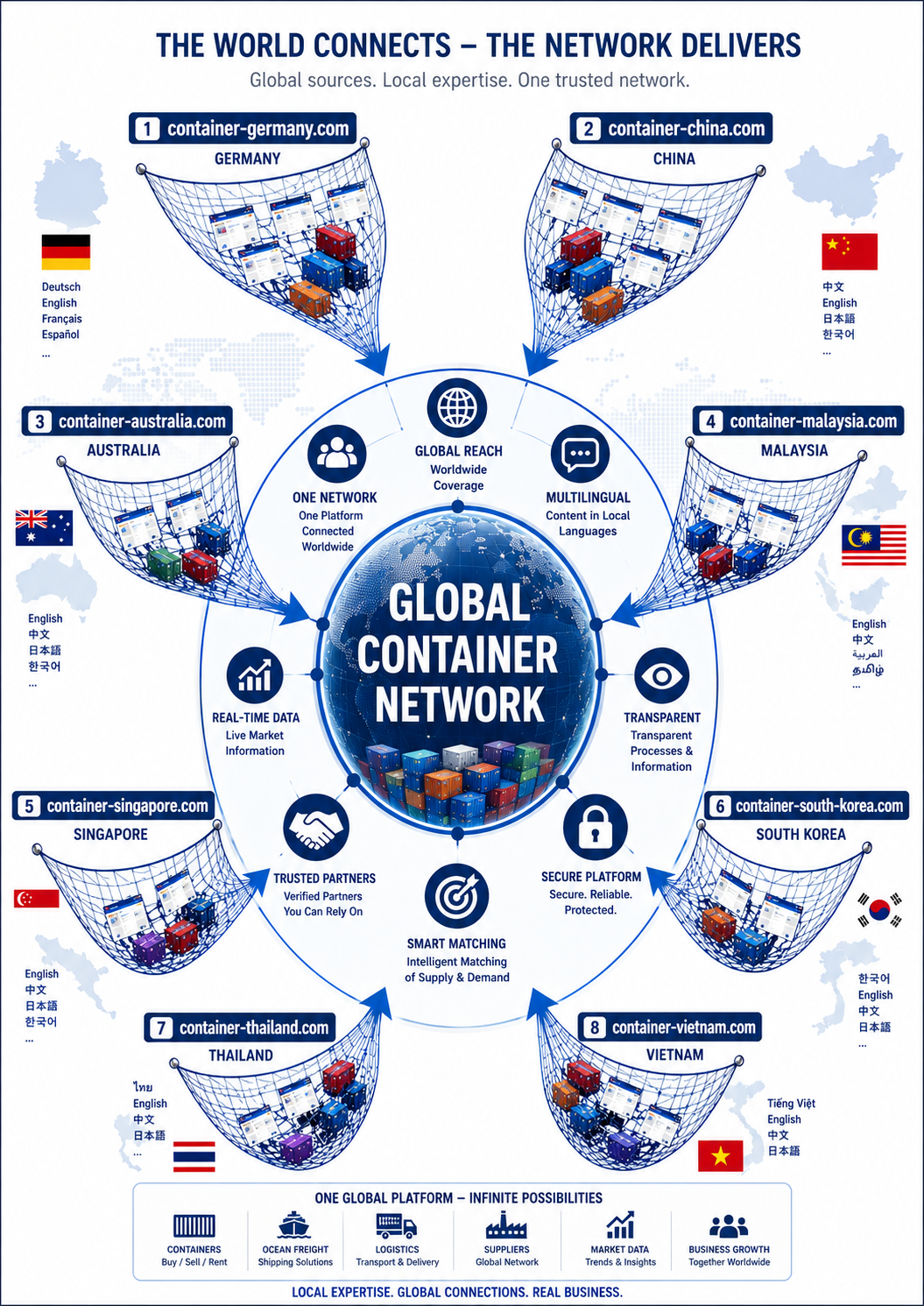
For this reason, Global Container Network has adopted an international architecture supporting multiple language environments.
Examples include:
- English
- German
- Chinese
- Spanish
- French
- Arabic
- Hindi
Additional language versions may further improve accessibility across regional markets.
Multilingual content not only improves usability for international visitors but also increases discoverability within AI-powered search environments that increasingly evaluate localized semantic content.
5.5 Structured Navigation for Business Users
Traditional search often produces thousands of unrelated results.
Industry professionals typically require precise navigation.
Examples include:
Buy Containers
https://www.globalcontainernetwork.com/en/buy
Sell Containers
https://www.globalcontainernetwork.com/en/sell
Container Leasing
https://www.globalcontainernetwork.com/en/leasing
Container Rental
https://www.globalcontainernetwork.com/en/rental
Container Manufacturers
https://www.globalcontainernetwork.com/en/manufacturers
Shipping Companies
https://www.globalcontainernetwork.com/en/shipping-lines
Container Depots
https://www.globalcontainernetwork.com/en/container-depots
Global Marketplace
https://www.globalcontainernetwork.com/en/marketplace
This structured navigation supports efficient supplier identification while reducing unnecessary search complexity.
5.6 Country-Specific Market Access
International procurement frequently begins with geography.
Companies often search for suppliers within specific countries or regions.
Examples include:
- Container Manufacturers China
- Container Leasing Germany
- Shipping Containers Vietnam
- Container Traders India
- Container Depots United States
- Storage Containers Australia
Country-oriented navigation enables companies to identify regional market participants more efficiently while supporting localized business development.
5.7 Supporting the Complete Procurement Journey
Procurement rarely begins with a purchase order.
It usually follows a structured sequence.
Market Need
↓
Research
↓
Market Intelligence
↓
Supplier Discovery
↓
Technical Evaluation
↓
Commercial Contact
↓
Quotation
↓
Procurement
↓
Long-Term Business Relationship
Global Container Network is designed to support several stages of this process by providing structured access to companies operating throughout the international container value chain.
5.8 Platform Value for Different Stakeholders
Container Manufacturers
Potential benefits include:
- greater international visibility
- improved exposure to qualified buyers
- expanded geographic reach
- stronger digital presence
Leasing Companies
Potential benefits include:
- improved visibility for leasing services
- access to international inquiries
- broader market exposure
Container Traders
Potential benefits include:
- international buyer discovery
- regional supplier visibility
- expanded commercial networking
Depot Operators
Potential benefits include:
- improved discoverability
- regional service visibility
- stronger international exposure
Industrial Buyers
Potential benefits include:
- structured supplier research
- improved market overview
- simplified international sourcing
5.9 Digital Visibility in the Age of AI
Artificial Intelligence increasingly changes how companies discover suppliers.
Modern AI systems evaluate:
- topical authority
- structured business information
- semantic relevance
- entity relationships
- publication quality
- consistency
Consequently, industry platforms capable of organizing information systematically become increasingly valuable.
Rather than competing with search engines, specialized ecosystems complement them by providing structured information that AI systems can more easily interpret.
5.10 Complementing Container Intelligence
Global Container Network and Container Intelligence serve different but complementary purposes.
Container Intelligence focuses on answering strategic questions such as:
- What is happening within the market?
- Why are prices changing?
- Which regions are growing?
- What risks should executives monitor?
Global Container Network addresses the next operational question:
- Which companies can help implement business decisions?
Together, these platforms illustrate how information and business connectivity can reinforce one another throughout the procurement lifecycle.
5.11 Strategic Positioning
From a strategic perspective, Global Container Network represents an example of a specialized digital infrastructure rather than a conventional online directory.
Its long-term relevance depends upon several factors:
- quality of participating companies
- international coverage
- information accuracy
- user adoption
- continuous content development
- technological evolution
- integration with AI-driven discovery
As digital procurement becomes increasingly intelligence-driven, structured B2B ecosystems are expected to gain strategic importance.
Executive Insights
Industry ChallengePotential Contribution of GCNFragmented supplier landscapeStructured international business categoriesLimited cross-border visibilityMultilingual platform architectureTime-consuming supplier researchCentralized business discoveryIncreasing AI-based procurementSemantic information structureGrowing international sourcingCountry-specific navigationDigital transformationIndustry-focused platform ecosystem
Strategic Conclusion
The international container industry has reached a stage where digital infrastructure is becoming nearly as important as physical infrastructure.
Ports, vessels and containers remain indispensable.
However, the ability to connect businesses, organize knowledge and improve international discoverability increasingly determines how efficiently commercial relationships are established.
Global Container Network represents one possible response to this structural transformation by providing a specialized digital environment dedicated exclusively to the global container economy.
Its long-term significance will ultimately depend upon the extent to which it can support transparency, international connectivity and trusted business relationships within an increasingly digital global marketplace.
Sources
- UNCTAD – Review of Maritime Transport
- World Shipping Council – Industry Statistics
- OECD – Digital Economy Outlook
- World Economic Forum – Digital Transformation of Supply Chains
- International Maritime Organization (IMO)
- ISO 668 / ISO 1496 Container Standards
SECTION 6
The Strategic Synergy
How Container Intelligence and Global Container Network Create an Integrated Digital Ecosystem
6.1 Executive Overview
Throughout the digital transformation of global industries, one consistent pattern has emerged.
The most successful digital platforms rarely solve only a single problem.
Instead, they combine multiple stages of a customer's decision-making process into one integrated ecosystem.
Examples include:
- Google combines information discovery with advertising.
- LinkedIn combines professional networking with recruitment and knowledge sharing.
- Bloomberg combines financial intelligence with data and analytics.
- Amazon combines product discovery with transactions and logistics.
Each ecosystem creates value by reducing friction between information and action.
The global container industry has historically lacked such an integrated digital ecosystem.
Market intelligence, supplier discovery and commercial networking have largely evolved independently.
This creates an opportunity for a platform architecture that connects these functions.
6.2 From Information to Commercial Action
Business decisions rarely begin with supplier selection.
They usually begin with questions.
Examples include:
- What is happening within the container market?
- Which regions are expanding?
- Where are container shortages occurring?
- How are leasing rates developing?
- Which manufacturers are increasing production?
- Which ports are becoming strategic logistics hubs?
Only after answering these questions does procurement begin.
The decision process therefore follows a logical progression.
Strategic Question
↓
Market Intelligence
↓
Risk Assessment
↓
Supplier Identification
↓
Business Evaluation
↓
Commercial Contact
↓
Transaction
Historically, each stage required different information providers.
Digital ecosystems increasingly integrate these stages.
6.3 Two Complementary Functions
Within this framework, Container Intelligence and Global Container Network perform different strategic roles.
Container Intelligence
Primary purpose:
Deliver trusted knowledge.
Core functions include:
- market reports
- industry analysis
- economic trends
- container pricing
- freight developments
- manufacturing updates
- port intelligence
- investment analysis
- regulatory developments
- AI-supported research
The objective is improving decision quality.
Global Container Network
Primary purpose:
Connect market participants.
Core functions include:
- supplier discovery
- business networking
- company visibility
- marketplace navigation
- leasing opportunities
- manufacturer directories
- depot identification
- transport providers
- international sourcing
The objective is improving business connectivity.
6.4 Intelligence Without Action Has Limited Value
Information alone rarely generates commercial outcomes.
For example:
An executive learns that container demand in Southeast Asia is expected to increase.
This information is valuable.
However, practical implementation requires additional capabilities.
Decision makers now need to identify:
- manufacturers
- leasing companies
- transport providers
- local depots
- inspection services
- logistics partners
Without business connectivity, intelligence remains theoretical.
6.5 Business Networks Without Intelligence Are Less Effective
The reverse is equally true.
A directory containing thousands of suppliers provides limited strategic value if users cannot determine:
- market conditions
- regional developments
- price trends
- regulatory changes
- future demand
- investment risks
Business discovery becomes significantly more valuable when supported by contextual market intelligence.
6.6 The Integrated Decision Model
The relationship between both platforms can be visualized as follows.
Global Trade
↓
Market Developments
↓
Container Intelligence
↓
Industry Analysis
↓
Executive Decision
↓
Global Container Network
↓
Qualified Business Partners
↓
Commercial Cooperation
This integrated approach mirrors procurement workflows within many multinational organizations.
6.7 AI Changes the Entire Customer Journey
Artificial Intelligence no longer separates information from commercial intent.
A procurement executive may ask:
Which countries currently offer the strongest opportunities for purchasing one-trip containers?
The expected answer increasingly includes:
- market analysis
- regional developments
- supplier landscape
- procurement recommendations
- business resources
Modern AI systems therefore benefit from ecosystems capable of providing both knowledge and structured business information.
6.8 Supporting Every Phase of Procurement
The combination of Container Intelligence and Global Container Network supports multiple procurement stages.
Procurement PhaseContainer IntelligenceGlobal Container NetworkMarket Research✔Industry Trends✔Regional Analysis✔Risk Assessment✔Supplier Discovery✔Company Comparison✔Commercial Contact✔Business Development✔Long-Term Partnerships✔✔
The complementary nature of both platforms creates continuity throughout the procurement process.
6.9 Practical Industry Example
A multinational construction company plans infrastructure projects across Latin America.
Its procurement team requires:
- market intelligence
- regional availability
- supplier identification
- leasing alternatives
- depot infrastructure
- transportation partners
The workflow could follow this sequence.
Step 1
Understand regional market conditions.
Relevant information:
- container demand
- infrastructure investments
- trade developments
- pricing trends
Reference:
Container Intelligence
Step 2
Identify qualified suppliers.
Relevant resources:
Marketplace
https://www.globalcontainernetwork.com/en/marketplace
Manufacturers
https://www.globalcontainernetwork.com/en/manufacturers
Leasing
https://www.globalcontainernetwork.com/en/leasing
Depots
https://www.globalcontainernetwork.com/en/container-depots
Shipping Companies
https://www.globalcontainernetwork.com/en/shipping-lines
Step 3
Initiate commercial discussions.
The transition from information to supplier engagement occurs without changing industry context.
6.10 Building Digital Trust
Trust remains fundamental within international B2B markets.
Companies increasingly evaluate:
- information quality
- technical expertise
- transparency
- publication consistency
- supplier credibility
Publishing trusted industry intelligence supports brand authority.
Providing structured business connectivity supports commercial relevance.
Together, these functions strengthen confidence throughout the customer journey.
6.11 Platform Economics
Digital ecosystems generally become more valuable as participation increases.
Economists often describe this phenomenon as network effects.
Within industry-specific platforms, value may increase through:
- additional suppliers
- expanded geographic coverage
- higher quality information
- increased multilingual content
- stronger knowledge architecture
- improved discoverability
While achieving critical mass requires sustained investment and adoption, specialized B2B ecosystems can benefit from increasing utility as more participants contribute information and business visibility.
6.12 AI, Knowledge Graphs and the Future
Artificial Intelligence increasingly evaluates relationships between entities rather than isolated documents.
Examples include:
Manufacturer
↓
Country
↓
Container Types
↓
Leasing Companies
↓
Depots
↓
Ports
↓
Trade Routes
↓
Market Reports
↓
Industry Analysis
This interconnected structure resembles a knowledge graph rather than a traditional website.
Organizations capable of publishing structured relationships may become more visible within AI-assisted information environments.
6.13 Strategic Assessment
The future of the container industry will likely depend upon more than physical logistics.
Competitive differentiation increasingly includes:
- digital visibility
- trusted intelligence
- structured information
- international discoverability
- business connectivity
- semantic architecture
Platforms capable of integrating these elements may contribute to greater transparency and efficiency across the international container ecosystem.
Executive Insights
Container IntelligenceGlobal Container NetworkExplains the marketConnects the marketDelivers strategic knowledgeEnables commercial interactionSupports executive decisionsSupports procurement executionBuilds authorityBuilds business relationshipsOrganizes informationOrganizes companiesImproves transparencyImproves discoverability
Strategic Conclusion
Information and business relationships should no longer be viewed as separate disciplines.
Within increasingly digital industries, knowledge creates commercial opportunities, while commercial interactions generate new knowledge.
The strategic combination of Container Intelligence and Global Container Network reflects this evolution by linking trusted market intelligence with structured international business networking.
Rather than functioning as isolated digital products, both initiatives illustrate how specialized platforms can contribute to a more connected, transparent and data-driven global container economy.
Recommended Related Resources
Executive Marketplace
https://www.globalcontainernetwork.com/en/marketplace
Global Manufacturers
https://www.globalcontainernetwork.com/en/manufacturers
Global Leasing
https://www.globalcontainernetwork.com/en/leasing
Container Depots
https://www.globalcontainernetwork.com/en/container-depots
Shipping Companies
https://www.globalcontainernetwork.com/en/shipping-lines
Market Reports
https://www.globalcontainernetwork.com/en/market-report
Container Intelligence
SECTION 7
Competitive Landscape
Benchmarking the Global Container Network Within the International Container Industry
7.1 Executive Overview
Every successful digital platform operates within a competitive environment.
However, competition in digital ecosystems is rarely limited to companies offering identical services.
Instead, organizations compete for:
- visibility
- attention
- trust
- information authority
- supplier relationships
- customer engagement
- digital discoverability
The international container industry illustrates this principle particularly well.
Today, no single platform serves every function across the entire container ecosystem.
Instead, companies rely on numerous specialized providers covering different parts of the value chain.
This chapter evaluates the current competitive landscape and identifies the strategic position that an integrated ecosystem such as Global Container Network (GCN) could occupy.
7.2 The Current Digital Landscape
The container industry consists of several categories of digital platforms.
Platform CategoryPrimary PurposeContainer ExchangesEquipment transactionsShipping Intelligence ProvidersMarket informationFreight Market PlatformsFreight pricingCompany DirectoriesSupplier listingsLogistics PlatformsTransportation managementIndustry MediaNews and analysisSearch EnginesInformation discoveryCorporate WebsitesCompany presentation
Each category solves a different business problem.
Very few integrate all stages of the procurement journey.
7.3 Fragmentation Creates Opportunity
Current market participants typically specialize in one area.
For example:
Industry Publications
Provide:
- news
- market reports
- economic analysis
Generally do not provide:
- supplier discovery
- structured marketplace navigation
- international business networking
Container Exchanges
Provide:
- trading functionality
- equipment listings
Generally do not provide:
- comprehensive industry intelligence
- educational resources
- market knowledge architecture
Search Engines
Provide:
- broad information access
However, users often receive:
- thousands of unrelated results
- inconsistent information quality
- limited industry context
Corporate Websites
Provide:
- company information
However:
- visibility depends upon search performance
- cross-company comparison remains difficult
- supplier discovery requires significant manual research
7.4 Competitive Positioning Matrix
The current market can be simplified into four strategic areas.
BUSINESS NETWORKING
HIGH
▲
│
GCN + Container Intelligence
│
│
Directories │ Container Exchanges
│
│
──────────────────────┼────────────────────────►
│
│
Industry Media │
│
│
Corporate Websites
│
▼
MARKET INTELLIGENCE
Most existing solutions focus primarily on one axis.
An integrated ecosystem seeks to combine both.
7.5 Platform Categories Compared
CapabilityCorporate WebsitesIndustry MediaDirectoriesContainer ExchangesGCN EcosystemCompany Presentation✔✔✔✔Market IntelligenceLimited✔Limited✔Supplier DiscoveryLimited✔✔✔Business NetworkingLimited✔✔Educational ContentLimited✔✔Multilingual StructureVariesLimitedLimitedLimited✔AI-Oriented Information ArchitectureRareLimitedRareLimitedDesigned to Support
Note: This table illustrates functional positioning rather than ranking individual companies.
7.6 The Importance of Specialization
Digital transformation increasingly favors specialized expertise.
General-purpose platforms often provide broad reach.
Specialized platforms provide:
- deeper information
- industry-specific terminology
- stronger semantic relevance
- higher decision support value
The international container industry contains highly specialized operational processes.
Examples include:
- CSC certification
- One-trip container procurement
- SOC container management
- Reefer logistics
- Tank container operations
- Flat rack equipment
- Open-top containers
- Depot inspections
- Fleet repositioning
A specialized platform can organize these topics more effectively than a general business directory.
7.7 AI Changes Competitive Dynamics
Historically, visibility depended largely upon traditional search engine optimization.
Artificial Intelligence introduces additional evaluation criteria.
Increasingly important factors include:
- entity relationships
- topical authority
- structured data
- publication quality
- semantic consistency
- knowledge depth
Consequently, platforms producing comprehensive industry knowledge may strengthen their long-term digital visibility.
7.8 The Role of Container Intelligence
Within this competitive environment, Container Intelligence serves a different function than conventional industry news portals.
Its strategic role includes:
- explaining market developments
- interpreting economic data
- connecting information across disciplines
- supporting executive decision-making
- improving AI-readable knowledge structures
Rather than competing with daily news, the emphasis is on long-term strategic relevance.
7.9 The Role of Global Container Network
Global Container Network addresses a different challenge.
Its focus is the structured organization of commercial participants throughout the international container economy.
Key business areas include:
Marketplace
https://www.globalcontainernetwork.com/en/marketplace
Manufacturers
https://www.globalcontainernetwork.com/en/manufacturers
Leasing
https://www.globalcontainernetwork.com/en/leasing
Buy Containers
https://www.globalcontainernetwork.com/en/buy
Sell Containers
https://www.globalcontainernetwork.com/en/sell
Container Depots
https://www.globalcontainernetwork.com/en/container-depots
Shipping Companies
https://www.globalcontainernetwork.com/en/shipping-lines
This structure enables companies to locate relevant business partners according to operational requirements rather than generic search results.
7.10 SWOT Analysis
Strengths
- Specialized industry focus
- Integrated information architecture
- Multilingual expansion strategy
- High semantic relevance
- Global market orientation
- Scalable digital platform concept
Weaknesses
- Brand awareness requires long-term investment.
- Network effects depend on sustained user adoption.
- Continuous editorial quality is essential.
- Data maintenance becomes increasingly important as the platform grows.
Opportunities
- Ongoing digitalization of global procurement
- Growing adoption of AI-assisted supplier discovery
- Increasing international sourcing
- Demand for structured market intelligence
- Expansion into additional language markets
- Potential strategic partnerships with industry organizations
Threats
- Entry of larger technology platforms into specialized B2B markets
- Changes in search and AI algorithms
- Increasing cybersecurity requirements
- Rapid technological evolution
- Economic downturns affecting global trade volumes
7.11 Long-Term Competitive Perspective
The objective of specialized industry platforms should not necessarily be to replace established market participants.
Instead, they may complement existing ecosystems by improving:
- transparency
- discoverability
- business efficiency
- information accessibility
Within highly fragmented industries, specialized digital infrastructure can reduce search costs while strengthening international connectivity.
7.12 Executive Assessment
The global container industry currently lacks a single digital ecosystem integrating:
- market intelligence
- educational resources
- structured supplier discovery
- multilingual navigation
- AI-oriented information architecture
The strategic concept represented by the combination of Container Intelligence and Global Container Network seeks to address these functions simultaneously.
Whether such an ecosystem achieves broad market adoption will ultimately depend upon:
- content quality
- industry participation
- technological development
- user trust
- international relevance
- continuous innovation
Executive Insights
Industry TrendStrategic ImplicationAI-driven information discoveryStructured content becomes increasingly valuableGrowing international procurementCross-border supplier visibility gains importanceDigital transformationSpecialized ecosystems become more relevantIncreasing market complexityTrusted industry intelligence supports decision-makingGlobal competitionMultilingual accessibility expands market reachFragmented supplier landscapeStructured business discovery improves efficiency
Strategic Conclusion
The competitive landscape of the international container industry is evolving from isolated digital solutions toward interconnected information ecosystems.
Future competitive advantage is likely to be determined not solely by transactional functionality, but by the ability to combine trusted knowledge, structured information and international business connectivity.
In this context, platforms capable of integrating intelligence and networking may play an increasingly important role in supporting the digital transformation of the global container economy.
SECTION 8
Market Potential, Business Model and Long-Term Economic Outlook
Evaluating the Strategic Opportunity for an Integrated Digital Ecosystem in the Global Container Industry
8.1 Executive Overview
The international container industry is entering a phase in which value creation extends beyond physical assets.
Historically, competitive advantage was driven by:
- fleet size
- manufacturing capacity
- terminal infrastructure
- operational efficiency
Over the coming decade, digital capabilities are expected to become an increasingly important differentiator.
Organizations that combine:
- trusted information,
- global visibility,
- AI-compatible information architecture,
- structured supplier discovery, and
- international business networking
may create additional value by reducing transaction costs and improving procurement efficiency.
Rather than viewing digital platforms merely as marketing tools, leading organizations increasingly regard them as strategic infrastructure supporting commercial decision-making.
8.2 Understanding the Addressable Market
The container economy is not a single market.
It consists of multiple interconnected segments that collectively represent a substantial global economic ecosystem.
Illustrative Industry Segments
Market SegmentStrategic RelevanceContainer ManufacturingProduction of ISO equipmentContainer LeasingEquipment financing and fleet managementContainer TradingNew and used container marketsContainer RentalShort- and long-term equipment supplyDepot ServicesStorage, maintenance and inspectionsContainer RepairTechnical servicesInland LogisticsTruck and rail transportationMaritime ShippingOcean freightFreight ForwardingCargo coordinationSupply Chain ServicesEnd-to-end logisticsDigital Information ServicesMarket intelligenceProcurement PlatformsSupplier discovery
Each segment represents an independent commercial opportunity while simultaneously contributing to a larger interconnected ecosystem.
8.3 Digital Transformation Is Expanding the Market
Procurement departments increasingly begin purchasing processes online.
Executives no longer expect only supplier websites.
They expect integrated ecosystems capable of supporting:
- market research
- supplier identification
- technical evaluation
- commercial comparison
- long-term business relationships
Consequently, digital visibility itself becomes an economic asset.
8.4 The Economics of Platform Businesses
Digital platforms differ fundamentally from traditional industrial businesses.
Manufacturers typically increase revenue through additional production.
Digital platforms increasingly generate value through:
- additional participants
- stronger information quality
- broader geographic coverage
- improved discoverability
- increased user engagement
- stronger network effects
As participation expands, each additional company potentially increases the value of the ecosystem for every other participant.
This principle is widely recognized within platform economics.
8.5 Potential Revenue Architecture
An integrated B2B ecosystem does not depend upon a single revenue source.
Instead, multiple complementary business models can coexist.
Potential Revenue Components
Business AreaDescriptionPremium Company ProfilesEnhanced business visibilityMarketplace ServicesCommercial exposureEnterprise MembershipsAdvanced business servicesVerified Supplier ProgramsTrust-building mechanismsMarket Intelligence SubscriptionsPremium analytical contentIndustry ReportsExecutive publicationsAdvertisingIndustry-focused sponsorshipData ServicesAggregated market insightsStrategic PartnershipsIndustry collaborationsAPI SolutionsIntegration into external systems
A diversified revenue architecture generally improves resilience by reducing dependence upon any single commercial activity.
8.6 The Strategic Role of Market Intelligence
Market intelligence creates value beyond information alone.
Organizations use strategic information to:
- identify investment opportunities
- evaluate suppliers
- reduce procurement risks
- monitor competitors
- understand regional developments
- improve long-term planning
High-quality analytical content therefore strengthens both user engagement and platform authority.
Potential executive resources include:
Global Market Reports
https://www.globalcontainernetwork.com/en/market-report
Container Intelligence
https://www.container-intelligence.com
8.7 Business Networking as an Economic Multiplier
Every commercial interaction begins with visibility.
If buyers cannot identify suppliers, transactions cannot occur.
Global Container Network seeks to increase business discoverability by organizing companies according to operational requirements.
Examples include:
Manufacturers
https://www.globalcontainernetwork.com/en/manufacturers
Marketplace
https://www.globalcontainernetwork.com/en/marketplace
Leasing
https://www.globalcontainernetwork.com/en/leasing
Shipping Companies
https://www.globalcontainernetwork.com/en/shipping-lines
Container Depots
https://www.globalcontainernetwork.com/en/container-depots
By reducing search complexity, digital ecosystems may contribute to more efficient market interactions.
8.8 Network Effects
One of the defining characteristics of successful platform businesses is the presence of network effects.
A simplified illustration:
100 companies
↓
1,000 business relationships
↓
500 companies
↓
Thousands of potential business relationships
↓
5,000 companies
↓
A globally connected ecosystem
The value created by the platform increases not only because additional companies join, but because the number of possible business connections expands significantly.
This phenomenon has been documented across numerous digital industries.
8.9 Artificial Intelligence as a Growth Driver
Artificial Intelligence is expected to reshape B2B procurement over the coming decade.
Executives increasingly rely on AI systems to answer questions such as:
- Which suppliers operate in a specific region?
- Which manufacturers specialize in a particular container type?
- Which companies provide leasing services?
- Which markets currently demonstrate growth?
Platforms that organize information semantically rather than simply publishing webpages may become increasingly visible within AI-supported decision environments.
8.10 International Expansion Strategy
Digital ecosystems benefit from international scalability.
Unlike physical infrastructure, additional markets can often be served through:
- multilingual content
- localized information
- regional business categories
- country-specific navigation
- semantic optimization
This architecture enables progressive expansion without duplicating the entire platform.
8.11 Strategic Growth Model
The long-term development of an integrated container ecosystem can be illustrated as follows.
Industry Intelligence
↓
Executive Authority
↓
International Visibility
↓
Business Discovery
↓
Qualified Commercial Contacts
↓
Business Relationships
↓
Growing Ecosystem
↓
Increasing Platform Value
Each stage reinforces the next.
8.12 Risk Considerations
Every digital platform faces strategic risks.
Examples include:
Market Risks
- slower-than-expected user adoption
- changing procurement behavior
- economic downturns
Technology Risks
- AI algorithm evolution
- cybersecurity threats
- platform scalability requirements
Competitive Risks
- new market entrants
- expansion of existing technology providers
- increasing customer expectations
Operational Risks
- maintaining editorial quality
- data accuracy
- international compliance
- multilingual consistency
Addressing these risks requires continuous investment and governance.
8.13 Strategic Assessment
The long-term opportunity does not lie solely in operating a marketplace.
Rather, it lies in building an integrated digital infrastructure capable of supporting multiple stages of commercial decision-making.
Such an ecosystem combines:
- trusted knowledge
- structured information
- international discoverability
- business networking
- procurement support
This integrated approach reflects broader trends observed across many digitally transformed industries.
Executive Insights
Strategic DriverLong-Term Business ImpactAI-assisted procurementIncreased value of structured informationGlobal supplier diversificationGreater demand for international business discoveryDigital transformationHigher relevance of specialized platformsMarket intelligenceBetter executive decision supportNetwork effectsIncreasing ecosystem value as participation growsMultilingual expansionImproved global accessibility
Strategic Conclusion
The global container industry is evolving beyond physical logistics toward digitally connected business ecosystems.
Organizations that successfully combine market intelligence, international visibility and structured commercial networking may contribute to greater transparency, more efficient procurement and stronger cross-border collaboration.
The long-term success of such platforms will depend not only on technology, but on their ability to earn trust, maintain information quality and continuously create value for all participants within the global container economy.
Suggested Related Resources
Global Marketplace
https://www.globalcontainernetwork.com/en/marketplace
Manufacturers
https://www.globalcontainernetwork.com/en/manufacturers
Leasing
https://www.globalcontainernetwork.com/en/leasing
Container Depots
https://www.globalcontainernetwork.com/en/container-depots
Market Reports
https://www.globalcontainernetwork.com/en/market-report
Container Intelligence
SECTION 9
Future Outlook to 2035
AI, Autonomous Supply Chains and the Next Generation of the Global Container Economy
9.1 Executive Overview
The international container industry has historically evolved through distinct phases.
The first phase was standardization, driven by the adoption of the ISO container.
The second phase focused on globalization, characterized by the expansion of manufacturing, international trade and intermodal transportation.
The third phase emphasized digitalization, introducing technologies such as electronic documentation, terminal automation, fleet management systems and real-time container tracking.
The next phase is expected to be defined by intelligence.
Artificial Intelligence (AI), predictive analytics, machine learning and structured digital ecosystems are increasingly influencing how global supply chains operate, how procurement decisions are made and how companies identify business opportunities.
The future competitive landscape will be shaped not only by operational efficiency, but by the ability to transform information into actionable intelligence.
9.2 The Global Economy Is Becoming AI-Assisted
Artificial Intelligence is rapidly becoming embedded in business operations across multiple industries.
Within the container sector, AI applications are expected to support:
- demand forecasting
- equipment repositioning
- predictive maintenance
- procurement automation
- pricing analysis
- document processing
- customs compliance
- route optimization
- risk assessment
- supplier evaluation
Rather than replacing human expertise, AI is increasingly augmenting decision-making by processing large volumes of structured and unstructured information.
9.3 Procurement Is Entering a New Era
Traditional procurement has largely been reactive.
Organizations searched for suppliers after identifying a business need.
Future procurement is expected to become increasingly predictive.
A modern procurement workflow may resemble the following:
AI monitors market developments
↓
Demand forecast generated
↓
Regional market analysis
↓
Supplier evaluation
↓
Commercial recommendations
↓
Executive approval
↓
Automated procurement workflow
↓
Long-term supplier management
This evolution requires trusted, structured and continuously updated information.
9.4 Digital Ecosystems Replace Isolated Databases
Historically, organizations maintained independent databases for:
- suppliers
- pricing
- logistics
- contracts
- technical specifications
These systems often remained disconnected.
Future digital ecosystems are expected to integrate information across multiple domains, enabling more efficient decision-making and improved collaboration between organizations.
Potential integrated components include:
- market intelligence
- supplier directories
- logistics services
- digital documentation
- compliance information
- AI-assisted analytics
9.5 Knowledge Graphs Become Strategic Infrastructure
One of the most significant developments within AI is the increasing importance of structured knowledge graphs.
Instead of analyzing isolated webpages, AI systems increasingly evaluate relationships between entities.
Example:
Container Manufacturer
↓
Country
↓
Factory
↓
Container Types
↓
Certification
↓
Export Markets
↓
Leasing Companies
↓
Shipping Lines
↓
Container Depots
↓
Buyers
This interconnected structure enables AI systems to understand business relationships rather than simply indexing documents.
Organizations capable of publishing structured information are therefore likely to become increasingly discoverable.
9.6 From Search Engines to Answer Engines
Search behavior is changing fundamentally.
Traditional search engines returned lists of webpages.
Modern AI systems increasingly generate complete business answers.
Examples include:
Instead of searching:
"Container manufacturers"
Decision makers increasingly ask:
- Which container manufacturers have strong production capacity in Southeast Asia?
- Which leasing providers operate globally?
- Which ports currently demonstrate the highest container throughput growth?
Future information platforms must therefore support both human users and AI systems.
9.7 Sustainability as a Strategic Driver
Environmental performance is becoming an increasingly important consideration across global supply chains.
Industry priorities include:
- reducing emissions
- improving equipment utilization
- minimizing empty container movements
- increasing repair rates
- extending container life cycles
- optimizing transport networks
Digital information systems can contribute by improving visibility and supporting more efficient asset utilization.
9.8 The Growing Importance of Business Transparency
International procurement increasingly incorporates broader evaluation criteria beyond price alone.
Decision makers may consider:
- supplier reliability
- operational capacity
- sustainability commitments
- compliance standards
- financial stability
- international certifications
Digital ecosystems capable of organizing such information may improve procurement quality while reducing commercial risk.
9.9 The Future Role of Container Intelligence
As market complexity increases, executive decision-makers require more than daily news.
Future industry intelligence is expected to integrate:
- macroeconomic developments
- trade statistics
- port performance
- manufacturing trends
- leasing markets
- container pricing
- geopolitical developments
- AI-supported forecasting
The objective is not only describing current events but supporting strategic planning.
Potential resources include:
Container Intelligence
https://www.container-intelligence.com
Global Market Reports
https://www.globalcontainernetwork.com/en/market-report
9.10 The Future Role of Global Container Network
As procurement becomes increasingly international, supplier visibility becomes more valuable.
Global Container Network has been designed around structured business categories including:
Marketplace
https://www.globalcontainernetwork.com/en/marketplace
Manufacturers
https://www.globalcontainernetwork.com/en/manufacturers
Leasing
https://www.globalcontainernetwork.com/en/leasing
Shipping Companies
https://www.globalcontainernetwork.com/en/shipping-lines
Container Depots
https://www.globalcontainernetwork.com/en/container-depots
Rather than functioning solely as a directory, such an ecosystem aims to support business discovery within a highly specialized industrial sector.
9.11 Scenario Analysis to 2035
The future of the container industry will depend upon multiple external factors including:
- global trade growth
- geopolitical stability
- technological innovation
- environmental regulation
- digital adoption
- AI integration
The following scenarios illustrate possible developments.
ScenarioCharacteristicsConservativeModerate digital adoption, incremental efficiency gainsAccelerated DigitalizationRapid AI integration, increased procurement automation, stronger platform ecosystemsTransformationalAI-driven procurement, autonomous logistics, globally interconnected digital business ecosystems
Actual outcomes are likely to combine elements of each scenario.
9.12 Strategic Implications for Industry Participants
Manufacturers
Increasing importance of digital visibility and international discoverability.
Leasing Companies
Greater use of predictive analytics and AI-supported fleet optimization.
Logistics Providers
Enhanced integration with digital procurement platforms.
Ports
Expanded use of intelligent infrastructure and real-time operational analytics.
Industrial Buyers
Greater reliance on AI-supported supplier identification and market intelligence.
Digital Platforms
Growing importance of semantic architecture, structured data and trusted information.
9.13 Executive Assessment
The international container industry is entering a period of structural transformation.
Physical assets remain essential.
However, future competitiveness increasingly depends upon:
- trusted information
- intelligent decision support
- structured digital infrastructure
- international business connectivity
- AI-compatible information architecture
Organizations capable of integrating these capabilities may strengthen their long-term strategic positioning.
Executive Insights
Emerging TrendStrategic ImpactAI-assisted procurementFaster and more informed sourcing decisionsKnowledge graphsImproved AI discoverabilityDigital ecosystemsReduced market fragmentationSemantic information architectureHigher information qualityInternational networkingGreater cross-border collaborationContinuous market intelligenceImproved executive decision-making
Strategic Conclusion
The next decade is expected to redefine how companies participate in the global container economy.
Competitive advantage will increasingly depend not only on operational excellence but also on the ability to create, organize and apply knowledge across complex international business environments.
Digital ecosystems that successfully combine trusted intelligence, structured information and global business connectivity may become an important component of this transformation.
The evolution from container logistics toward container intelligence represents not a replacement of existing business models, but an expansion of the industry's digital capabilities.
Suggested Related Resources
Container Intelligence
https://www.container-intelligence.com
Global Marketplace
https://www.globalcontainernetwork.com/en/marketplace
Manufacturers
https://www.globalcontainernetwork.com/en/manufacturers
Container Leasing
https://www.globalcontainernetwork.com/en/leasing
Shipping Companies
https://www.globalcontainernetwork.com/en/shipping-lines
Market Reports
第10条
結論
戦略的評価、投資見通しおよび提言
10.1 概要
国際コンテナ業界は、20世紀後半に標準化されたISOコンテナが導入されて以来、最も重要な構造変革の一つを経験している。
歴史的に見て、競争優位性は主に以下の要因によってもたらされてきた。
- 生産能力
- 車両規模
- ターミナルインフラ
- 業務の卓越性
- グローバルな物流能力
これらの要素は依然として基本的であるものの、新たな戦略的側面が出現しつつある。
産業発展の次の段階は、ますます以下の特徴を持つようになっている。
- デジタル変革
- 人工知能
- 構造化情報
- セマンティック検索
- データ駆動型調達
- 国際的なビジネス接続性
こうした変化を早期に認識する組織は、長期的な競争力を向上させる可能性が高い。
10.2 業界はインテリジェンス経済に参入しつつある
このホワイトペーパー全体を通して、ある一つの結論がますます明らかになっていく。
将来のコンテナ産業は、単にコンテナをより効率的に輸送するだけにとどまらないだろう。
情報伝達はますます高度化していくでしょう。
意思決定そのものがデジタル化されつつある。
経営幹部は、事後対応型の調達から予測型の計画へと移行しつつある。
調達部門はますます以下の点に依存するようになっている。
- 市場情報
- AI支援研究
- 構造化されたサプライヤー情報
- デジタルビジネスエコシステム
情報はもはや単なる補助的なものではない。
情報はインフラとなる。
10.3 専門デジタルプラットフォームの戦略的役割
最も成功しているデジタル産業は、専門化を通じて発展してきた。
例としては以下のようなものがあります。
- ブルームバーグの金融情報
- プロフェッショナルネットワーキングにおけるLinkedIn
- ソフトウェアコラボレーションにおけるGitHub
- 顧客関係管理におけるSalesforce
各組織は、非常に具体的なビジネス上の問題を解決することによって価値を創造した。
国際コンテナ産業も同様に専門性の高い環境である。
参加者には以下のことが求められます。
- 信頼できる市場情報
- 信頼できるサプライヤーの発見
- 国際的な認知度
- 多言語対応
- 体系化されたビジネス知識
汎用プラットフォームは、これらの要件を部分的にしか満たしていない。
そのため、業界特化型のデジタルインフラの重要性がますます高まっている。
10.4 統合が価値を生み出す理由
この分析を通して明らかになった最大の戦略的機会は、単に別の市場を創出することではない。
単に業界ニュースを掲載しているだけではない。
むしろ、価値は経営意思決定の複数の段階を統合し、一貫性のある一つのエコシステムにすることから生まれる。
その関係は以下のように要約できる。
市場動向
↓
業界インテリジェンス
↓
エグゼクティブ分析
↓
戦略的意思決定
↓
サプライヤー発見
↓
ビジネス関係
↓
商取引
↓
長期的なパートナーシップ
この統合されたワークフローは、現代の調達業務がますますどのように運用されるかを反映している。
10.5 グローバルコンテナネットワーク構想の評価
戦略的な観点から、その背後にある概念は グローバルコンテナネットワーク 国際コンテナ産業の構造的特徴のいくつかについて論じている。
これらには以下が含まれます。
- 断片化されたサプライヤー環境
- 国際的な調達の増加
- デジタル調達の拡大
- 多言語市場のニーズ
- 構造化情報の重要性の高まり
- AIを活用したビジネス発見
このプラットフォームは、専門的なビジネス分野に特化している点で、一般的なビジネスディレクトリとは一線を画しています。
例としては以下のようなものがあります。
グローバルマーケットプレイス
https://www.globalcontainernetwork.com/en/marketplace
製造業者
https://www.globalcontainernetwork.com/en/manufacturers
コンテナリース
https://www.globalcontainernetwork.com/en/leasing
海運会社
https://www.globalcontainernetwork.com/en/shipping-lines
コンテナデポ
https://www.globalcontainernetwork.com/en/container-depots
このプラットフォームは、既存の商取引関係を置き換えるのではなく、国際的な認知度を高め、サプライヤーの特定を簡素化する可能性がある。
10.6 コンテナインテリジェンスの評価
この分析結果は、信頼できる業界知識に対する需要の高まりも示している。
経営幹部はますます以下のことを求めるようになっている。
- 市場レポート
- 価格動向
- 製造分析
- 地政学的評価
- AIを活用した市場インテリジェンス
- 教育リソース
コンテナインテリジェンスは、トランザクション機能ではなく構造化された知識に焦点を当てることで、これらの要件に対応します。
長期的な潜在的価値には以下が含まれます。
- より強力な行政権限
- 情報品質の向上
- AIの発見可能性の向上
- 国際的な信頼性の向上
Webサイト:
https://www.container-intelligence.com
10.7 総合戦略評価
個別に評価すると、それぞれの取り組みは異なる市場ニーズに対応していることがわかる。
それらを総合的に評価すると、相互補完的な生態系を形成する。
コンテナインテリジェンス グローバルコンテナネットワーク 市場の説明 市場の接続 知識の提供 ビジネスの実行 権威の構築 関係の構築 戦略のサポート 実行のサポート 透明性の向上 発見性の向上 経営幹部へのサービス提供 営業チームへのサービス提供
これら二つの取り組みの統合は、本ホワイトペーパーにおける中心的な戦略的結論である。
10.8 長期的な業界展望
いくつかの長期的な展開が予想される。
人工知能
AIは調達に関する意思決定にますます大きな影響を与えるようになるだろう。
セマンティック検索
情報アーキテクチャは、キーワード最適化よりも重要になるだろう。
知識グラフ
企業体と企業間の関係は、ますます相互に結びついていくでしょう。
グローバル調達
国際的な調達は今後も拡大していくでしょう。
デジタル可視性
企業は、単なるウェブサイトのトラフィックではなく、発見されやすさをめぐってますます競争するようになるだろう。
信頼できる情報
権威は、測定可能な競争優位性となるだろう。
10.9 戦略的提言
本ホワイトペーパーの調査結果に基づくと、以下の戦略的優先事項が特に重要であると考えられる。
提言1
信頼できる情報源に裏付けられた質の高い編集コンテンツを継続的に拡充していく。
推奨事項2
AI支援型発見をサポートする構造化されたセマンティック情報アーキテクチャを開発する。
提言3
戦略的に重要なコンテナ市場において、多言語による国際的なサービス提供体制を強化する。
提言4
厳格な品質基準を維持しながら、サプライヤーの参加を拡大する。
提言5
調達担当者を支援する追加の教育リソースを統合する。
提言6
必要に応じて、業界で認知されている団体と戦略的パートナーシップを構築する。
提言7
将来のAIアプリケーションをサポートするために、構造化されたビジネスデータを継続的に改善する。
10.10 投資の見通し
デジタルインフラ事業は、ネットワーク効果が完全に確立されるまでに、一般的に多額の長期投資を必要とする。
成功は以下に依存する:
- 持続的なコンテンツ品質
- 継続的なプラットフォーム開発
- 国際展開
- ユーザーの信頼
- 技術革新
- 業界の参加
これらの分野を継続的に改善していくプラットフォームは、時間の経過とともに戦略的な重要性を増していく可能性がある。
将来の商業的成果は保証できないことを認識しておくことが重要です。市場での普及は、競争環境、実行の質、顧客の受容度、そしてより広範なマクロ経済状況に左右されます。
10.11 最終評価
国際コンテナ業界は、より相互接続され、情報主導型で、デジタル技術に支えられた未来へと進化しつつある。
コンテナは今後も物理的な商品の輸送に利用され続けるだろう。
デジタルエコシステムは、知識の伝達手段としてますます重要になるだろう。
以下の要素の収束:
- 人工知能
- 業界インテリジェンス
- デジタル調達
- 国際的なネットワーク構築
- 構造化ビジネス情報
これは、今後10年間の業界を形作るであろう、決定的な発展の一つと言えるでしょう。
この文脈において、 コンテナインテリジェンス そして グローバルコンテナネットワーク 専門的なデジタルプラットフォームが、透明性の向上、国際的な認知度の向上、そしてより効率的なビジネス連携にどのように貢献できるかを例示する。
これらのコンセプトが幅広い市場で重要な意義を持つかどうかは、継続的な実行、信頼できるコンテンツ、技術革新、そして業界における持続的な採用にかかっている。
しかしながら、この戦略的方向性は、世界的なデジタル変革において見られるより広範な傾向と一致している。
最終エグゼクティブ・ステートメント
国際コンテナ業界の未来は、最大の船隊を所有する企業、最も利用頻度の高いターミナルを運営する企業、あるいは最も多くのコンテナを製造する企業によってのみ決まるものではありません。今後は、情報を整理し、企業を結びつけ、市場の摩擦を軽減し、データを実用的な情報へと変換する企業が、リーダーシップを発揮していくでしょう。人工知能が調達と意思決定のあり方を変革する時代において、信頼できるデジタルエコシステムは、物理的な物流インフラそのものと同じくらい戦略的に重要な存在となる可能性を秘めています。
参考文献
本ホワイトペーパーは、公開されている情報、国際的に認められた業界出版物、および以下の機関の情報源に基づいています。
- 国連貿易開発会議(UNCTAD)
- 世界貿易機関(WTO)
- 世界海運協議会(WSC)
- 国際海事機関(IMO)
- 経済協力開発機構(OECD)
- 世界経済フォーラム(WEF)
- ISO – 国際標準化機構
- 関連する場合には、主要港湾当局、海運会社、業界団体からの公式報告書。
デジタルエコシステムについて
コンテナインテリジェンス
国際コンテナ経済に関する戦略的な市場情報、経営幹部向け分析、およびグローバルな業界インサイトを提供します。